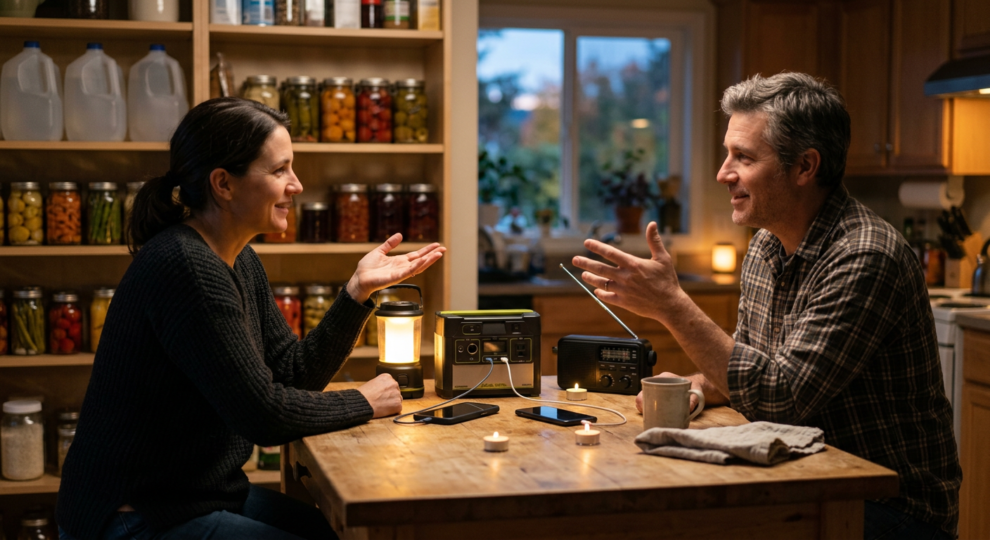
Power outages used to be a weather story. Lately they keep showing up in the national news for other reasons: aging infrastructure, cyber incidents, and plenty of geopolitical noise about attacks on power grids. You do not need to follow any of that closely to notice the pattern. The grid is reliable most of the time, and getting more fragile at the edges.
Here is the good news: preparing your household for a grid-down scenario is not a bunker project. It is a short list of ordinary supplies, a couple of habits, and one afternoon of planning. This guide walks through what actually happens when the power fails, what to do in the first hour, and how to cover light, water, food, power, and communication without panic or a second mortgage.
What actually happens when the grid goes down
Most outages are short. A tree limb, a transformer, a few dark hours, and the lights come back. The scenarios worth preparing for are the ones measured in days, because that is when the second-order effects start, and most people have never thought them through.
- City water can stop. Water utilities rely on electric pumps and treatment plants. In a long outage, pressure drops and advisories follow. Tap water may become unsafe before it stops flowing.
- Cell networks congest fast. Towers have backup batteries that last hours, not days. Everyone calling at once makes it worse. Text messages often get through when calls do not.
- Card payments fail. Stores with generators may still be open, but if their internet and payment terminals are down, cash is the only thing that works.
- The refrigerator clock starts. A full fridge keeps food safe about four hours unopened. A full freezer holds roughly 48 hours. That is a real deadline, not a suggestion.
- Gas stations stop pumping. Pumps are electric. In regional outages, stations within driving distance can all be down at once.
None of this is reason for alarm. It is just the difference between an inconvenience and a genuinely hard week. Everything below is about making that week ordinary instead of dramatic.
The first hour: a calm checklist
When the lights go out, most people do the same three things: find a flashlight, check whether it is just their house, and open the fridge. Do those, then work this short list:
- Confirm the scope. Look outside. Streetlights out and neighbors on porches means a wider outage. Report it if your utility takes reports.
- Switch the fridge and freezer to closed. Decide now: they stay shut unless someone is actively eating. Tape a note on the freezer if your household needs the reminder.
- Get one light per person. Headlamps or lanterns beat flashlights for anything that takes two hands.
- Check your phones, then switch them to low-power mode. Treat the remaining battery like the fuel gauge of the only car you have.
- Get one reliable information source running. A phone on low power, a battery radio, or a hand-crank unit. Then stop refreshing. News does not change faster than the power situation does.
That is the whole first hour. No heroics. The rest of this guide covers each system your household relies on, in the order that matters during an extended outage.
Light: hands-free beats bright
Candles feel classic and cause a surprising number of house fires during outages. LED lanterns and headlamps are safer, brighter where it counts, and run for days on the same batteries. Keep one light where people sleep and one in the kitchen, and you have already solved most of an outage’s mood problems. Our rundown of the best emergency lights for power outages covers the models worth owning.
Water: the dependency nobody notices
The standard advice is one gallon per person per day, and that number is real. A family of four riding out a week needs 28 gallons for drinking and cooking alone, before anyone washes a dish. Two practical layers cover it:
- Stored water. Filled water jugs rotate cheaply, and stacked in a closet they vanish from your attention until needed. Start with three days, build to a week.
- The ability to purify more. A gravity filter or a boiling plan turns questionable water into safe water, which stretches your stored supply from days into weeks. If you have never thought about where your water comes from when the pumps stop, start with our guide to stockpiling food and water, and keep a method for purifying water without power on the shelf.
Food and cooking without the kitchen
An electric stove is the first casualty of an outage, and the second is everything in the fridge. The fix is a pantry built around foods you actually eat, plus one way to cook them outdoors.
- Eat what you store. Canned soups, pasta, oatmeal, peanut butter, and shelf-stable milk cover a week without drama. Rotate by eating from the pantry and replacing, so nothing expires in the dark.
- One backup stove. A two-burner camp stove with a few fuel canisters handles coffee, rice, and reheating indefinitely. We compared the best portable camping stoves for emergency cooking if you want one that earns its shelf space.
- Freezer triage. In a multi-day outage, eat refrigerator food first, freezer food second, pantry last. If the outage is long and it is cold outside, a cool porch or a cooler with snow beats letting a freezer’s worth of food spoil.
- Long-shelf-life backups. Freeze-dried meals and emergency food kits are the insurance layer: they store for decades and cook with just hot water. Our reviews of emergency food storage kits and freeze-dried food for long-term storage compare taste and value honestly, including what we would skip.
Power: what a household can realistically run
The goal during an outage is not to live normally. It is to keep a short list of essentials alive: phones, lights, a radio, maybe a CPAP or a medication fridge. Match the tool to the job:
- Charging only: a solar power bank tops off phones and headlamps forever, silently, for the cost of a nice dinner out. See the models that actually recharge in our solar power bank comparison.
- Essentials for days: a mid-size power station runs lights, phones, a radio, and small medical devices, and pairs with a solar panel for indefinite runtime. We tested the best solar generators for emergency power across price tiers.
- Whole-comfort backup: a fuel generator can run a fridge, a furnace fan, or a window unit, with the usual rules: outside only, far from windows, fuel stored safely. Our winter power outage guide covers the generator specifics and the cold-weather extras most guides skip.
Most households land on the first two tiers. That combination is quiet, safe indoors, and never runs out of fuel.
Information and family communication
In any serious outage, the two questions every family asks are “what is happening?” and “where is everyone?” Answer both before you need to.
- One radio that does not need the grid. A hand-crank or battery NOAA weather radio with AM/FM is the household’s link to official information when phones are dead or congested. Our emergency radio comparison covers hand-crank, solar, and NOAA models.
- A family plan that fits on an index card. An out-of-state contact everyone texts (texts squeeze through congestion), two meeting points, and radios for the cars. Walkie-talkies cover the neighborhood radius without any network at all. We picked the best walkie talkies for emergency communication and put together a full emergency communication guide for power outages.
- Old-school information habits. When phones and internet are gone, battery radios, official stations, and even a battery-powered weather alert unit keep you informed without rumors. Our guide to staying informed when power and internet fail walks through it.
Medical and safety extras
Two additions round out the household kit. First, a first aid kit you have actually opened, stocked for the injuries that happen during outages: cuts, burns from candles and stoves, and the medication list for everyone in the house. Our first aid kit comparison covers home-ready options. Second, cash in small bills. In a multi-day outage, card networks fail long before stores do, and twenty dollars in ones and fives buys groceries that a full wallet cannot.
EMP talk, minus the panic
Grid attacks and electromagnetic pulses get a lot of airtime in the headlines lately, so it is worth a calm paragraph. An EMP is a burst of energy, natural (a solar storm) or man-made (a high-altitude nuclear detonation), that can damage electronics and the grid’s high-voltage equipment. The realistic picture from the studies that exist: most cars and small household devices survive, but the grid’s largest transformers are slow to replace, which makes the plausible worst case a long regional blackout, not a movie scene.
Notice what that means. The household-level preparation for an EMP scenario is almost exactly the preparation for a week-long blackout: stored water, shelf-stable food, off-grid light and power, and a radio that works without infrastructure. A Faraday cage for a spare radio and a set of batteries (a metal trash can with a lid, or a homemade foil-and-box shield) is a reasonable extra that costs an afternoon. Beyond that, anyone selling you EMP-specific fear is selling something. The blackout plan you build this month covers the scenario.
Build it in stages, not in a weekend frenzy
Trying to buy preparedness in one afternoon is how closets fill with regret. Instead, climb a simple ladder:
| Stage | Goal | What it looks like |
|---|---|---|
| 72 hours | Ride out any routine outage comfortably | Lights per person, three days of water and easy food, one radio, phone charging, fridge discipline |
| One week | Handle a serious regional outage | A week of water and food, a backup stove with fuel, solar or battery power for essentials, cash in small bills, a written family communication plan |
| Two weeks | Be the calm house on the street | Water purification to extend stored supply, longer-term food storage, a power station with solar input, spare batteries shielded from an EMP worst case |
Each stage is a few hundred dollars at most, spread over a month or two of normal shopping. Nothing on the list is exotic, and almost all of it gets used outside of emergencies anyway: camp stoves cook on camping trips, power banks charge phones daily, and lanterns go on every power cut, planned or not.
The calm takeaway
Grid failures make the news when they are big, but the preparation that matters is small, local, and boring: light that works, water you stored, food you already eat, a radio, and a plan your family has actually read. Pick the one stage you are behind on and handle it this week. Everything else on this page will wait patiently on the shelf, right where a calm household keeps it.
If you want a single starting point, read our original grid-failure preparedness guide alongside this one, then work through the ladder above. Preparedness is not a personality. It is a Saturday afternoon and a short list.