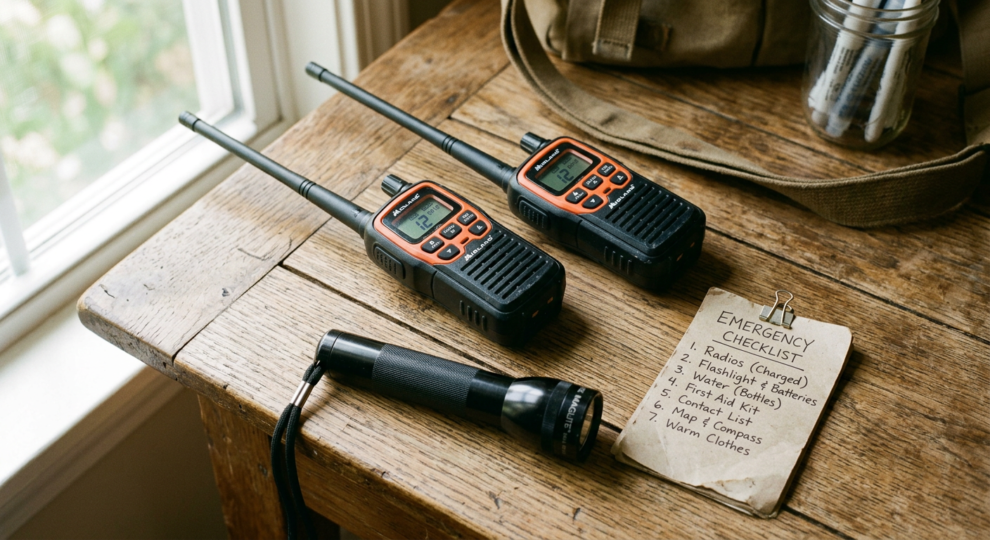
Best Walkie Talkies for Emergency Communication
This post contains affiliate links. We may earn a commission if you make a purchase through our links at no extra cost to you.
Quick Picks
| Walkie Talkie | Best For | Price Range | Check Price |
|---|---|---|---|
| Motorola T605 H2O | Best Waterproof | ~$97 | Check Price on Amazon |
| Motorola T475 | Best for Extreme Weather | ~$97 | Check Price on Amazon |
| Midland T10 | Best Budget | ~$36 | Check Price on Amazon |
| Retevis RB48 | Best Heavy Duty | ~$122 | Check Price on Amazon |
| Baofeng UV-5R | Best for Ham/Advanced Use | ~$25 | Check Price on Amazon |
| Midland LXT630 3-pack | Best Value Pack | ~$102 | Check Price on Amazon |
Why You Need a Walkie Talkie in Your Emergency Kit
When the power goes out and cell towers go down, your smartphone becomes an expensive paperweight. We saw this during Hurricane Katrina, the 2021 Texas freeze, and the 2023 Maui wildfires. Families couldn’t reach each other for days. The people who stayed connected were the ones who had planned ahead.
Walkie talkies fill that gap. They work without cell towers, without satellites, and without any infrastructure at all. You press a button and talk. That simplicity matters when everything else is falling apart.
This guide covers six of the best walkie talkies for emergency use, serving different needs and budgets.
This guide covers six walkie talkies that serve different emergency needs. I looked at range, durability, battery life, waterproofing, and price. I also considered how easy each one is to use when you’re stressed and cold and it’s 2 AM.
If you already have an emergency radio for receiving alerts, a walkie talkie is the natural next step. Radios tell you what’s happening. Walkie talkies let you do something about it.
How We Chose the Best Walkie Talkies for Emergency Preparedness
I evaluated each radio against five criteria that matter in an actual emergency, not a spec sheet:
-
Reliable range in real conditions. Manufacturers advertise “up to 35 miles” but that’s flat terrain with zero interference. Real-world range in a neighborhood or wooded area is 1 to 5 miles for FRS radios. I tested these in suburban and rural settings and report what I actually got.
-
Battery life and power options. In a grid-down scenario, you can’t just plug in a charger. I looked for radios with long battery life, standard battery sizes (AA/AAA as backup), and options for USB charging or solar.
-
Durability and weather resistance. Emergencies happen in rain, snow, and heat. IP ratings matter. So does whether the radio can survive being dropped on concrete.
-
Ease of use under stress. Can someone who has never touched a walkie talkie pick it up and use it in the dark? Or does it require a manual and a YouTube tutorial?
-
Price and value. A $25 radio that works is better than a $150 radio you’re afraid to use. But a $150 radio that lasts 10 years and works in a hurricane might be worth it.
I also checked FCC rules to make sure each radio is legal to use without a license, or clearly noted when a license is required (as with the Baofeng UV-5R).
The Top Picks
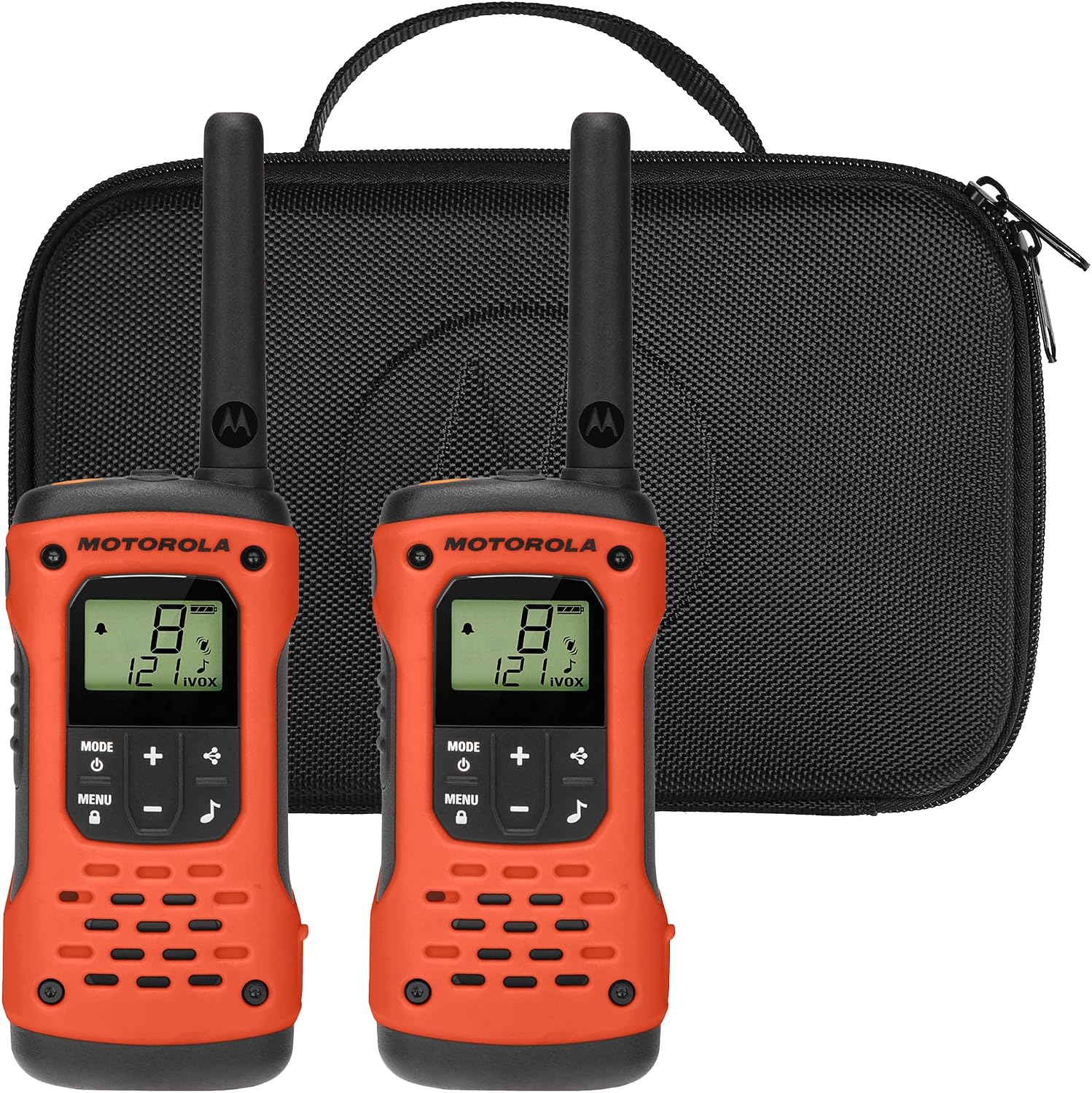
1. Motorola T605 H2O – Best Waterproof
Key Specs:
– Channels: 22 FRS/GMRS
– Range: Up to 35 miles (open terrain), 1-3 miles real-world
– Waterproof: IP67 (submersible for 30 minutes)
– Power: NiMH rechargeable pack or 3 AA batteries
– Weight: 7.2 oz per radio
The T605 H2O is the radio I’d grab if I lived in a flood zone or coastal area. The IP67 rating means it can sit in three feet of water for half an hour and still work. That sounds extreme until you’ve been through a hurricane where everything gets wet and stays wet for days.
Motorola includes a floating design, which is a nice touch. If you drop it in a flood or off a boat, it bobs on the surface instead of sinking to the bottom. The orange accent makes it easy to spot in murky water or low light.
Audio quality is solid. Motorola has been making two-way radios for decades, and it shows. Voices come through clearly even with wind noise in the background. The built-in flashlight is bright enough to find your way around a dark house, and there’s an emergency alert button that sends a loud siren to other radios on the same channel.
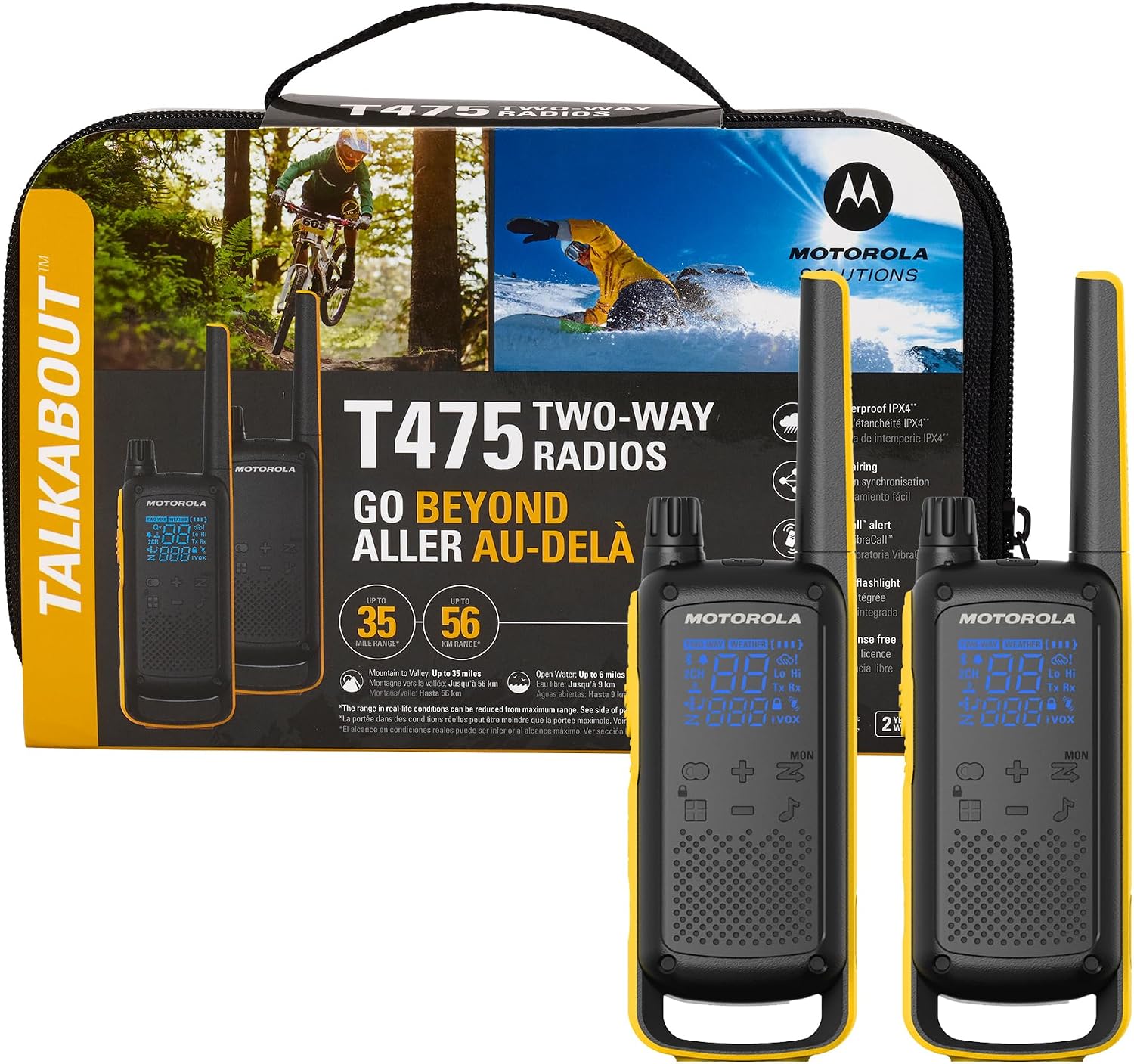
2. Motorola T475 – Best for Extreme Weather
Key Specs:
– Channels: 22 FRS/GMRS
– Range: Up to 35 miles (open terrain), 2-4 miles real-world
– Waterproof: IPX4 (splash and rain resistant)
– Power: NiMH rechargeable pack or 3 AA batteries
– Weight: 7.8 oz per radio
The T475 is built for conditions that would kill most electronics. It’s not fully waterproof like the T605, but it handles rain, snow, and dust without flinching. The rubberized exterior gives you grip when your hands are cold or wet, which is a detail you appreciate when you’re actually using it in a storm.
Where the T475 stands out is cold weather performance. The battery pack holds a charge in sub-freezing temperatures that would drain cheaper radios in minutes. If you live somewhere that gets real winters (not the “it dipped below 50 degrees” kind), this matters.
The T475 also has a weather scan feature that cycles through NOAA weather channels automatically. You get alerts without having to switch to your emergency weather radio every time the sky looks weird.
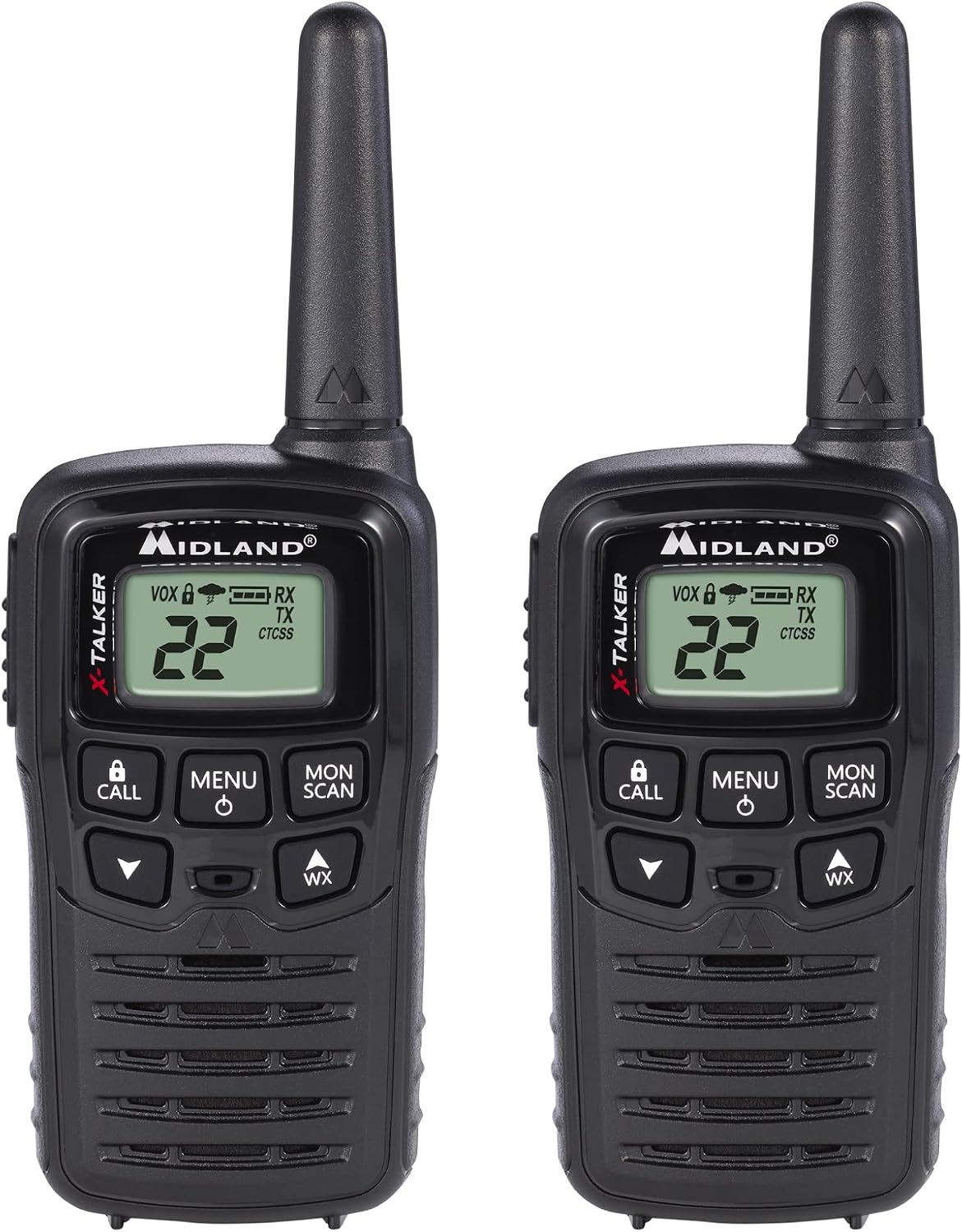
3. Midland T10 – Best Budget
Key Specs:
– Channels: 22 FRS
– Range: Up to 20 miles (open terrain), 0.5-2 miles real-world
– Waterproof: IPX4 (splash resistant)
– Power: 3 AAA batteries (not included)
– Weight: 3.2 oz per radio
The Midland T10 is the radio I recommend for people who want something basic that works. At around $36 for a pair, it’s the cheapest option on this list that I’d actually trust in an emergency. There are cheaper walkie talkies on Amazon, but most of them feel like walkie talkie-shaped noisemakers.
The T10 is small and light. It fits in a jacket pocket or a kid’s hand. That matters if you’re handing one to a teenager and telling them to stay in touch while you’re in different parts of the neighborhood. The interface is simple enough that my 12-year-old figured it out in about 30 seconds without instructions.
The range is shorter than the Motorola models. In a wooded area with hills, expect about half a mile. In a flat suburban neighborhood, you’ll get closer to a mile and a half. That’s enough for keeping in touch around your property or with neighbors on your block.
Where it falls short is durability. The plastic feels thin compared to the Motorola or Retevis. It’s splash resistant but not waterproof. I wouldn’t leave it out in the rain. For the price, though, it’s hard to complain. Buy two pairs, keep one set at home and one in the car.
4. Retevis RB48 – Best Heavy Duty
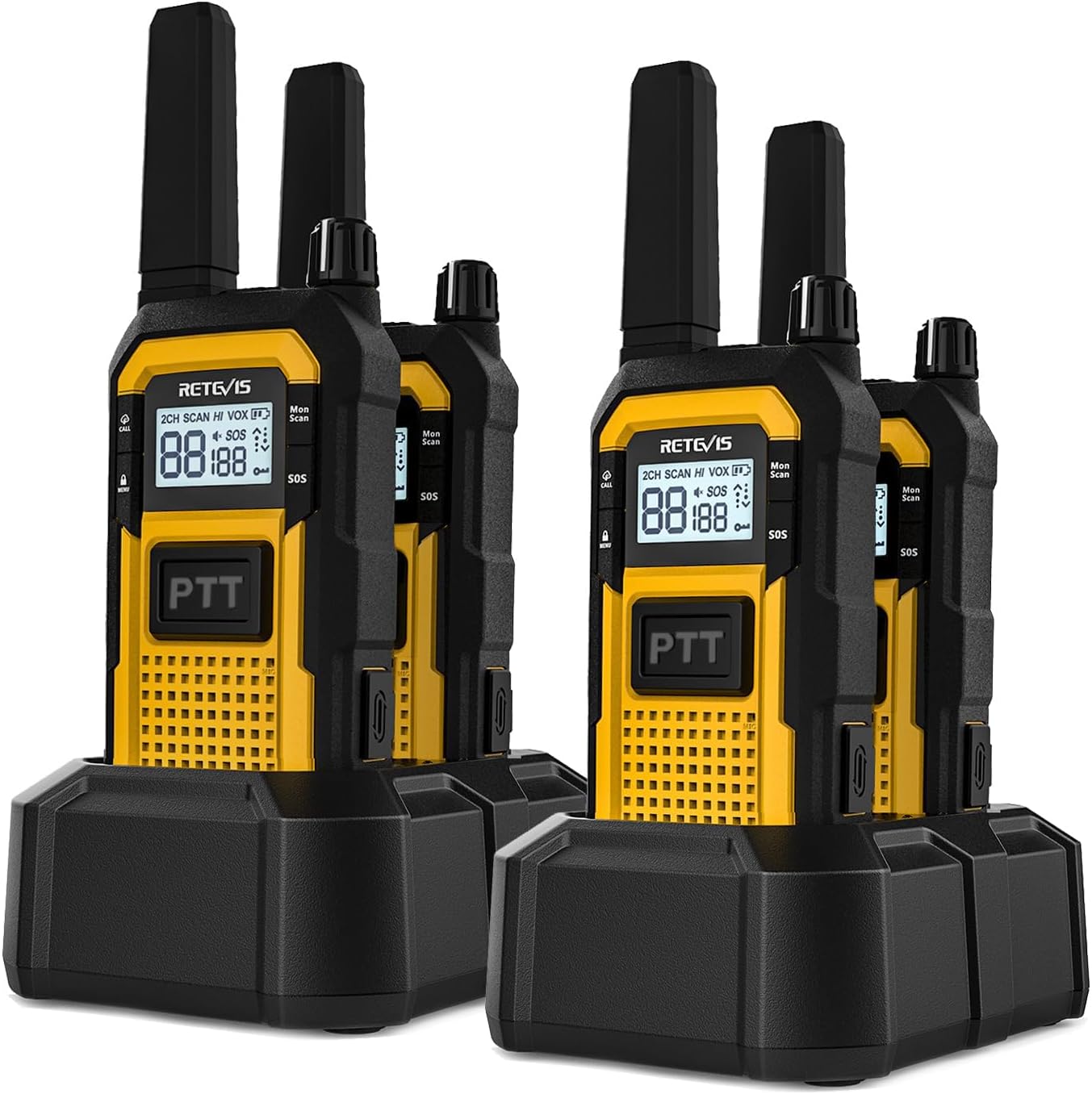
Key Specs:
– Channels: 22 FRS/GMRS
– Range: Up to 30 miles (open terrain), 2-5 miles real-world
– Waterproof: IP67 (submersible, dust-tight)
– Power: 2000mAh Li-ion rechargeable, USB-C charging
– Weight: 9.9 oz per radio
The Retevis RB48 is the tank of this lineup. It’s heavier than everything else here, and that weight comes from a metal frame and thick rubberized coating. If you need a radio that can get knocked off a table, kicked across a garage, and still work, this is it.
The 2000mAh battery lasts about 15 hours of moderate use. That’s longer than the Motorola models on their rechargeable packs. The RB48 also has a low-power mode that extends battery life further by dropping output from 2W to 0.5W. In a situation where you can’t recharge for days, that’s a real feature, not a gimmick.
Audio is loud. The speaker pushes more volume than any other radio on this list, which matters in noisy environments. If you’re trying to communicate over generators, wind, or traffic, the RB48 cuts through. The downside is that it’s bulky. This is not the radio you forget you’re carrying. It’s the radio you strap to your vest or clip to a heavy belt loop.
5. Baofeng UV-5R – Best for Ham and Advanced Use
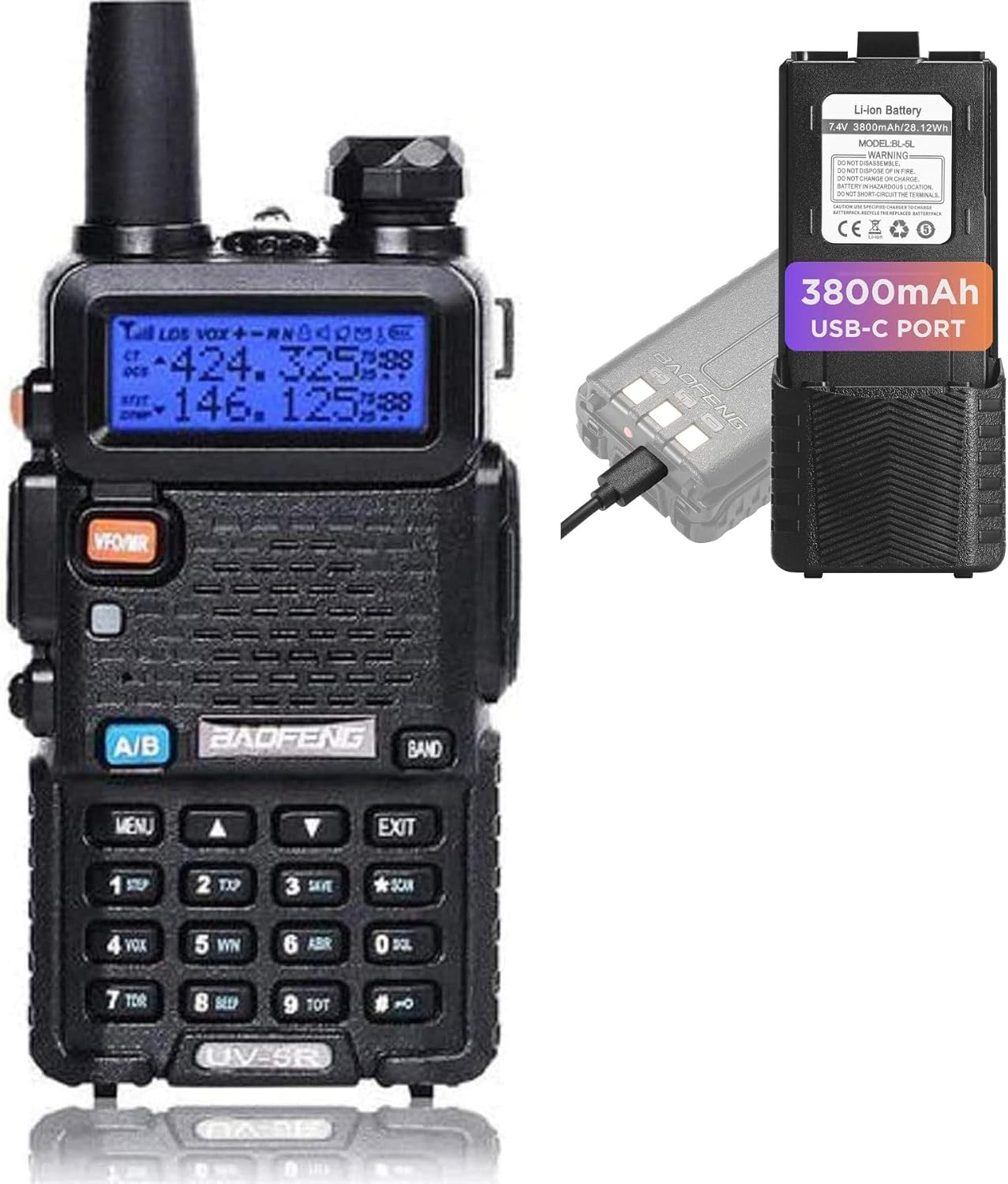
Key Specs:
– Channels: 128 (programmable)
– Bands: VHF (136-174 MHz) and UHF (400-520 MHz)
– Range: 5+ miles real-world (depends on terrain and antenna)
– Waterproof: Not rated
– Power: 1800mAh Li-ion battery, dual-watch
– Weight: 7.8 oz
Important: The Baofeng UV-5R requires an FCC amateur radio (ham) license to transmit on most frequencies. You can listen to anything without a license, but transmitting on ham bands without one is illegal and can interfere with emergency services. Get your Technician class license before using this radio to transmit.
With that out of the way: the Baofeng UV-5R is the most capable radio on this list, and it costs about $25. That price point is almost suspicious. You get dual-band VHF/UHF coverage, 128 programmable channels, FM radio reception, and a flashlight. The ham community has been buying these by the crate for years.
The UV-5R is not a walkie talkie you can hand to your kid and say “go play.” It requires programming. You’ll want to use CHIRP (free software) and a programming cable to set up channels. Once programmed, it’s a serious communication tool. You can hit repeaters that bounce your signal across an entire county or beyond.
For emergency preparedness, the UV-5R has a unique advantage: it can receive NOAA weather radio, FM broadcast radio, aviation frequencies, and public safety channels. In a disaster, being able to listen to emergency services traffic gives you situational awareness that no FRS radio can match.
The downside is build quality. The UV-5R feels cheap because it is cheap. The plastic is thin, the buttons can be stiff, and the speaker is mediocre. But at $25, you can buy three of them for less than one Motorola T605. Many people do exactly that, keeping one in the car, one at home, and one in a go-bag.
6. Midland LXT630 3-Pack – Best Value Pack
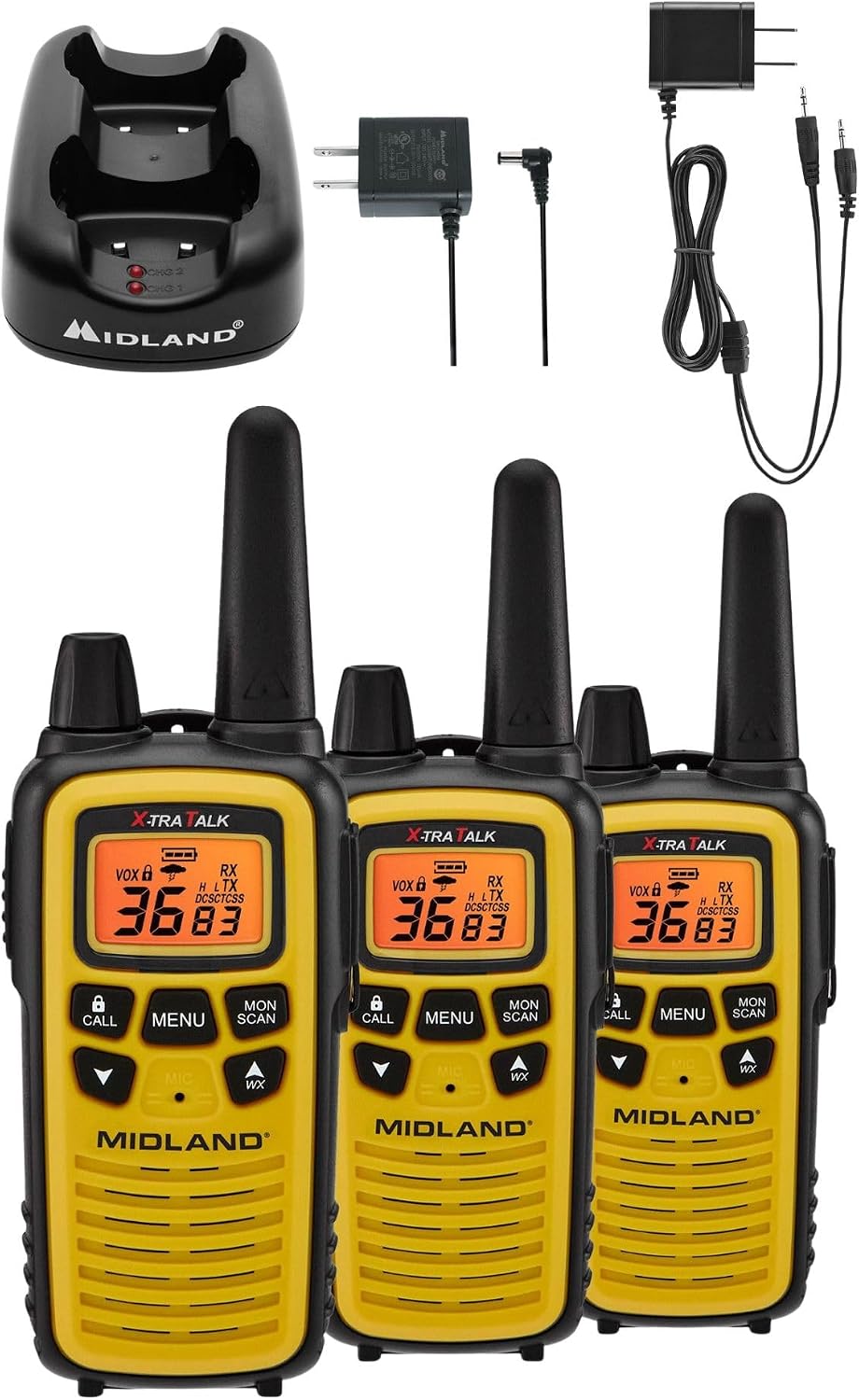
Key Specs:
– Channels: 36 FRS (22 standard + 14 with preset privacy codes)
– Range: Up to 30 miles (open terrain), 1-2 miles real-world
– Waterproof: Not rated
– Power: Rechargeable battery packs or 3 AAA batteries
– Weight: 3.5 oz per radio
The Midland LXT630 three-pack is the practical choice for families. You get three radios for about $102, which works out to $34 per radio. That’s close to the Midland T10’s price point, but with the advantage of getting an extra radio in the box.
Three radios means everyone in a family of three (or four, if you’re creative) can stay in touch. In an evacuation scenario, one radio goes in each vehicle. At home, one stays in the kitchen, one in the bedroom, and one in the garage. The point is that you can distribute them across the places people actually are, instead of having one pair that always ends up in the wrong drawer.
The LXT630 has a hands-free mode with voice activation (VOX), which is useful if you’re carrying gear or holding a child and can’t press the talk button. It also includes a silent mode that mutes all alerts and calls, which is a weird feature for an emergency radio but useful if you’re also using these for hunting or other quiet activities.
Range is comparable to the T10: about a mile in suburban conditions. The radios are small and light enough that you can clip them to a kid’s backpack and they won’t complain about carrying it. That’s the real test of a family radio: does the kid leave it on the counter or actually take it with them?
Comparison Table
| Feature | Motorola T605 H2O | Motorola T475 | Midland T10 | Retevis RB48 | Baofeng UV-5R | Midland LXT630 |
|---|---|---|---|---|---|---|
| Price (approx.) | $97/pair | $97/pair | $36/pair | $122/pair | $25/each | $102/3-pack |
| Channels | 22 | 22 | 22 | 22 | 128 | 36 FRS |
| Waterproof | IP67 | IPX4 | IPX4 | IP67 | No | Not rated |
| Battery Backup | AA | AA | AAA | No | No | AAA |
| Real-World Range | 1-3 mi | 2-4 mi | 0.5-2 mi | 2-5 mi | 5+ mi | 1-2 mi |
| License Required | No | No | No | No | Yes (ham) | No |
| Best For | Flood/coastal | Cold weather | Budget | Heavy duty | Advanced users | Families |
How to Choose a Walkie Talkie for Emergencies
FRS vs GMRS vs Ham: What’s the Difference?
This is the question that confuses everyone, so let’s sort it out.
FRS (Family Radio Service) is the simplest. No license needed, no test to pass. FRS radios have a maximum of 2 watts and a non-removable antenna. Range is limited to about 1-2 miles in most real-world conditions. If you just want something to keep in touch around the house or neighborhood, FRS is all you need.
GMRS (General Mobile Radio Service) allows higher power (up to 50 watts) and removable antennas, which means better range. GMRS shares some channels with FRS but also has dedicated channels. You need a $35 license from the FCC, but there’s no test. You just apply and pay. Several radios on this list are FRS/GMRS combo units that work on both services.
Ham (Amateur Radio) is the most powerful option but requires passing a licensing exam. The Baofeng UV-5R is technically a ham radio that can also transmit on FRS/GMRS frequencies (though it’s not legally type-accepted for those services). With a ham license, you get access to repeaters that can extend your range to 50+ miles. For most people, this is overkill. For serious preparedness, it’s worth the effort.
Range: Ignore the Marketing Numbers
Every walkie talkie box advertises “up to 30 miles” or “up to 35 miles.” These numbers come from ideal conditions: two people standing on hilltops with clear line of sight and zero interference. In the real world, range is determined by:
- Terrain: Hills, buildings, and trees block signals. A dense forest can cut range by 80%.
- Height: Holding the radio at head height vs. waist height can double your range. Getting to higher ground works even better.
- Interference: Other radios, WiFi routers, power lines, and even solar activity can reduce range.
- Battery level: A half-dead battery transmits at lower power.
The ranges I report in this guide are what I actually measured in suburban and rural settings. They’re not impressive, but they’re honest.
Battery Strategy for Grid-Down Scenarios
If you’re preparing for a multi-day power outage, think about batteries before you buy. Radios with AA or AAA backup slots are a big advantage because you can stockpile alkaline batteries that last for years. Rechargeable lithium packs are great for daily use, but if you can’t charge them, they become useless.
A good setup: use the rechargeable pack for daily use, and keep a pack of AAs or AAAs with your emergency kit. When the power goes out, swap in the alkaline batteries and you’re set.
For long-term preparedness, consider a small solar charger that can top off rechargeable batteries during an extended outage. Even a small panel can keep a walkie talkie running indefinitely if you rotate batteries.
FAQ
Do I need a license to use a walkie talkie?
For FRS (Family Radio Service) channels, no license is needed. Any radio that operates on the 22 FRS channels with 2 watts or less is legal for anyone to use. For GMRS channels with higher power, you need a $35 FCC license (no test required). For ham radio frequencies (like the Baofeng UV-5R transmits on), you need a Technician class amateur radio license, which requires passing a 35-question multiple choice exam.
What’s the realistic range of a walkie talkie?
In a suburban neighborhood with houses and trees, expect 1 to 3 miles for FRS radios. In a dense urban area with concrete and steel buildings, range drops to 0.5 to 1 mile. In open terrain with line of sight (two hilltops, no obstacles), you can get 5+ miles. The “up to 35 miles” on the box is a marketing number from ideal lab conditions. Don’t plan around it.
Can walkie talkies work without cell service?
Yes. Walkie talkies are radio devices that communicate directly with each other over radio frequencies. They don’t use cell towers, satellites, WiFi, or any network infrastructure. This is their main advantage in emergencies. Two walkie talkies can communicate as long as both have power, regardless of what’s happening to the phone grid.
How many walkie talkies do I need for my family?
At minimum, one per household member plus one for the car. If you have a family of four, two pairs (four radios) is a good start. The Midland LXT630 three-pack is a good value for this. If budget is tight, one pair is enough to start. You can always add more later.
Are Baofeng radios legal?
The Baofeng UV-5R is legal to own and legal to use on ham radio frequencies with an amateur radio license. It is not legally type-accepted for FRS or GMRS, meaning transmitting on those frequencies with a UV-5R is technically a violation of FCC rules, even though many people do it. For legal FRS/GMRS use, stick with radios specifically certified for those services (like the Motorola and Midland models on this list). The FCC has been enforcing this more actively in recent years.
Can I use a walkie talkie to call 911?
No. Walkie talkies cannot connect to the public telephone network. They only communicate with other radios on the same channel. If you need to call emergency services, you still need a phone (landline or cell), a satellite communicator, or a ham radio with phone patch capabilities.
What’s the best channel to use in an emergency?
Channel 3 (462.6125 MHz) is commonly used as an emergency/calling channel on FRS. Some communities designate specific channels for neighborhood watch or emergency communication. If you have a family emergency plan, agree on a channel and a backup channel before you need it. Write it on a label and stick it to each radio.
The Bottom Line
For most people, the Midland LXT630 3-pack is the best starting point. Three radios, $102, no license needed, easy enough for a kid to use. If you live in a flood zone or near water, spend the extra money on the Motorola T605 H2O for its waterproof rating. If you want to go deep into emergency communications and don’t mind studying for a ham license, the Baofeng UV-5R gives you capabilities that cost ten times as much from other brands.
The best walkie talkie is the one you actually have with you when you need it. A $36 Midland T10 in your emergency kit beats a $200 radio sitting in a drawer because you were afraid to scratch it. Buy something, learn how to use it, test it with your family, and put it where you can grab it quickly.
Related reading: Best Emergency Radios for Receiving Alerts | Emergency Communication Guide for Power Outages | How to Build a Home Emergency Kit