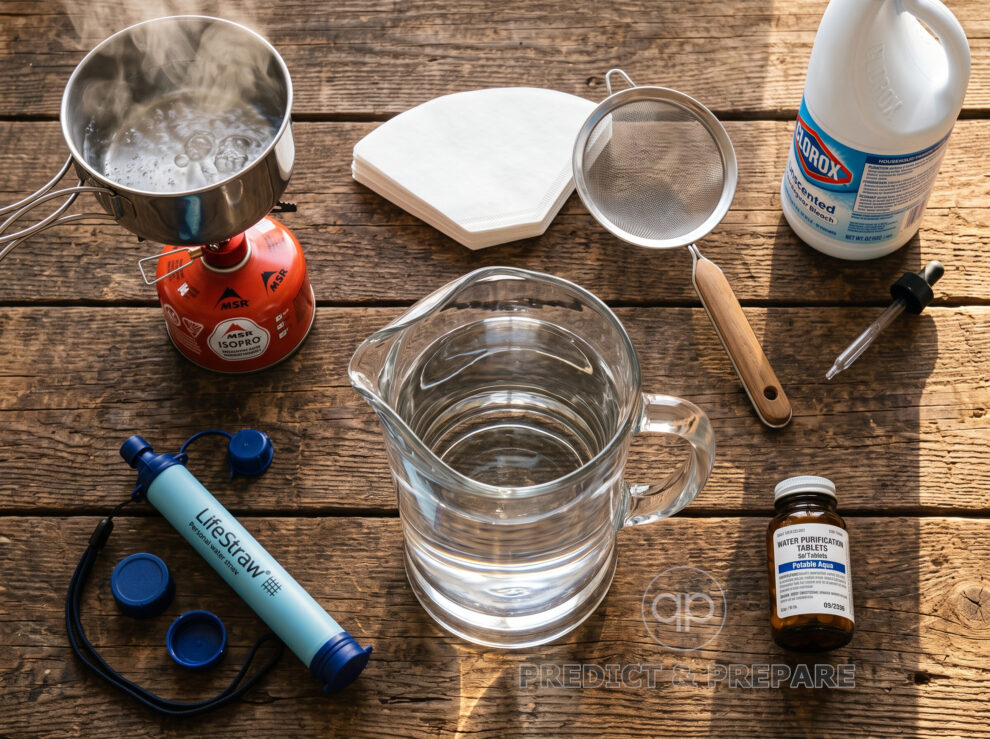
When the tap runs dry, what then? I’ve always wondered about that, haven’t you? We take water for granted; we turn the faucet, and there it is. What happens when the comfort of our modern lives fades into a distant memory and we’re forced to fend for ourselves? Access to clean water isn’t just a convenience; it’s the bedrock of survival. I’m writing this because I believe being prepared isn’t just for the doomsday-obsessed. It’s a practical necessity.
The Unseen Threat
Facing the Facts
Can you quench your thirst when the system fails? The hard truth is, even in developed nations, access to clean water isn’t guaranteed. The illusion of constant availability masks a vulnerability; water infrastructure is aging, and disasters strike without warning. Complacency is a luxury preppers can’t afford.
The Shadows in the Depths
Uncover the hidden dangers. Waterborne pathogens, such as bacteria, viruses, and parasites, lurk unseen, turning a life-giving resource into a vector for disease. Compromised systems expose you to industrial pollutants and chemical runoff. Tap water, often taken for granted, can become a toxic cocktail in an instant. You must see it
Numbers That Speak Volumes
The numbers don’t lie. Global statistics regarding water scarcity and contamination serve as a stark warning. Millions lack access to safe drinking water which fuels conflicts and displaces populations. Every drop counts toward survival. Did the market quiet when you approached?
Intel is Your Shield
Don’t wait for the “all clear” signal. Knowledge is your first line of defense against contaminated water sources. Start by understanding your local water supply: Where does it originate, and what are its vulnerabilities? Research potential threats, from natural disasters to infrastructure failures. Assess the risks. Pause to assess how the vibe changes your approach, process the situation and then make the first attempt.
Water. Without a Grid
1. Bridging Eras
High tech meets no tech. Know both. A multilayered approach to water purification provides redundancy when one system fails. The more familiar you are with methods of creating clean water, the more likely you are to survive. See when the grid fails for further tips. The first glance is everything, don’t misinterpret the information.
Ceramic and Microfiltration
Ceramic and microfilters are low-tech, power-free solutions for removing sediment and bacteria. They are your first line of defense, whether it’s a portable filter for your go-bag or a gravity-fed system for your base of operations.
Harnessing the Sun
Harness the Sun’s power. Solar desalination uses sunlight to evaporate water, leaving behind salts and other impurities; the purified vapor is then condensed and collected. A basic still can be constructed from readily available materials, such as plastic sheeting and containers. Scan the available materials. Assess what works and what doesn’t. Adapt
UV Purification
UV purification systems offer portable options for disinfection when the grid’s down, whether it’s solar or battery-powered. A quick pause lets your instincts process the vibe. Did you feel it? Your senses are your greatest tools, water is your foundation.
2. The Boiling Point
Boiling water is the tried-and-true method for killing pathogens. Bring water to a rolling boil for at least one minute at sea level; increase boiling time at higher altitudes. This method targets waterborne pathogens such as Giardia and Cryptosporidium.
Chemical Warfare. Your Water’s Enemy
1. Precision Strikes
Use with precision. The power of chemical treatment lies in its ability to neutralize pathogens, but only if applied correctly. Incorrect dosage can render water unsafe, defeating the purpose and endangering lives. It has everything to do with the drop. Take the time to observe, calculate, and recalibrate.
Chlorine Bleach
Master the drops. Chlorine bleach disinfection is a crucial tool in your arsenal, if used strategically. Use regular, unscented household bleach containing 5.25% to 8.25% sodium hypochlorite. Add the appropriate amount of bleach to the water supply, mix well, and let it stand for at least 30 minutes before use. The dilution factor is crucial for success.
Iodine Tablets
Iodine purification is a reliable method. See a guide to health crisis before proceeding. Follow the manufacturer’s instructions carefully, using the correct number of tablets for the volume of water being treated. When you have 1 liter, you are more likely to survive. Observe, adapt, and overcome.
Halogens Demystified
Halogens Demystified. While effective, prolonged use of iodine can pose health risks, especially for pregnant women and individuals with thyroid conditions. Safe and effective, only if you know the rules. Know the risks. Know the vulnerabilities.
2. The Rules of Engagement
The key is to follow guidelines, or face the consequences. Over-treatment can lead to health issues, while under-treatment leaves you vulnerable to waterborne diseases. Read the fine print, understand the risks, and mitigate the dangers. Every ruined town has an unspoken structure, and mastery is decoding it before the enemy moves.
Turning Murky to Clear. Coagulation
1. Beyond the Surface
Muddy water needs more than just disinfection. Suspended particles can shield pathogens from chemical treatments and reduce the effectiveness of filters. Sediment muddies the waters of water filtration. Clear the fog and your path becomes more visible.
Clarity is Key
Clarity is key. Coagulation is essential because it removes suspended particles that cloud water and harbor pathogens. This process improves the effectiveness of subsequent filtration and disinfection methods.
Alum’s Role
Alum’s critical role. Your emergency clarification agent, alum, or aluminum sulfate, is a chemical compound that causes suspended particles to clump together. Adding alum to muddy water initiates flocculation, making it easier to remove impurities.
The Invisible Web
Flocculation factors. During flocculation, particles aggregate to form larger clumps, called “flocs.” These flocs settle out of the water, can be strained out, or filtered, leaving clearer water. It is about removing what is unnecessary and seeing the big picture and small nuances.
2. Crystal Clear
Every step counts toward drinkable water. Coagulation is not a standalone solution. After clarification, water must still be disinfected to eliminate any remaining pathogens. Always double check and triple check your water to ensure that you are drinking fresh water and that it presents no possible harm.
The Vault. Strategic Water Storage.
1. Security Measures
Purified water secured is peace of mind ensured. Stockpiling water is a core tenet of prepping, but only if done correctly. Neglecting proper storage protocols can lead to contamination and render your reserves useless. Remember, you are playing the long game, planning, and preparing for unforeseen events. For more advice, read about emergency preparedness.
Container Selection
Container selection is paramount. Use food-grade, BPA-free plastic containers or glass bottles for water storage. Avoid re-contamination by thoroughly cleaning and sanitizing containers before filling them. Use a bleach solution to achieve the best sanitation results.
Quality Control
Quality control is the means to long-term safety. Implement regular manual checks to determine water quality for long-term storage. Look for signs of cloudiness, discoloration, or foul odor. If contamination is suspected, discard the water. Strive for the best quality you can find, never settle for subpar water quality.
Labeling and Tracking
A system for managing your supply is crucial. Label each container with the date of storage and a description of any treatments applied. Maintain a log to track usage and rotation, ensuring that older supplies are used first. Use simple systems, and share with your trusted allies.
2. Safeguarding the Source
Contamination is a constant threat. Don’t let your hard work go to waste. Store water in a cool, dark place away from direct sunlight and heat sources. This prevents algae growth and degradation of containers. Prepare for the unseen.
Remote Ops. Water Resilience
1. Adaptable Solutions
Away from civilization or amidst total chaos, the rules change. Grid-dependent solutions become liabilities in a SHTF scenario. You need strategies that work anywhere, anytime, regardless of external infrastructure. Adaptability will be your key to success.
Off-Grid Mastery
Off-grid mastery demands creative solutions. Solar-powered systems are one example, providing renewable energy for pumping, filtration, and UV disinfection in remote areas. Build your own DIY water purification station. Learn to operate with nothing.
The Essential Arsenal
Disaster-ready kits are non-negotiable. Must-have water purification equipment includes portable filters, collapsible containers, water purification tablets, and instructional materials. Pack them in a durable, waterproof bag for easy transport. Make sure you get exactly hat you need, nothing more, nothing less.
The Knowledge Advantage
The knowledge advantage. Transform crisis into opportunity by having insight and training. Check this survival urban environment guide. Know where to find water, how to purify it, and how to store it. The first glance is everything, don’t misinterpret the information.
2. Survival Imperatives
Water. It’s non-negotiable. Be ready for anything. The ability to find, purify, and store water is the difference between survival and collapse. Your strategic thinking, your resources, and your resilience can allow you to outlast the chaos.
Final Thoughts
It’s time to stop taking clean water for granted and embrace a proactive approach to water security, whether it’s mastering filtration techniques, understanding chemical treatments, or building a strategic reserve. The threat is real, and the time to prepare is now. Master these skills, stockpile your resources, and prepare your strategy now to prevail in the collapse.