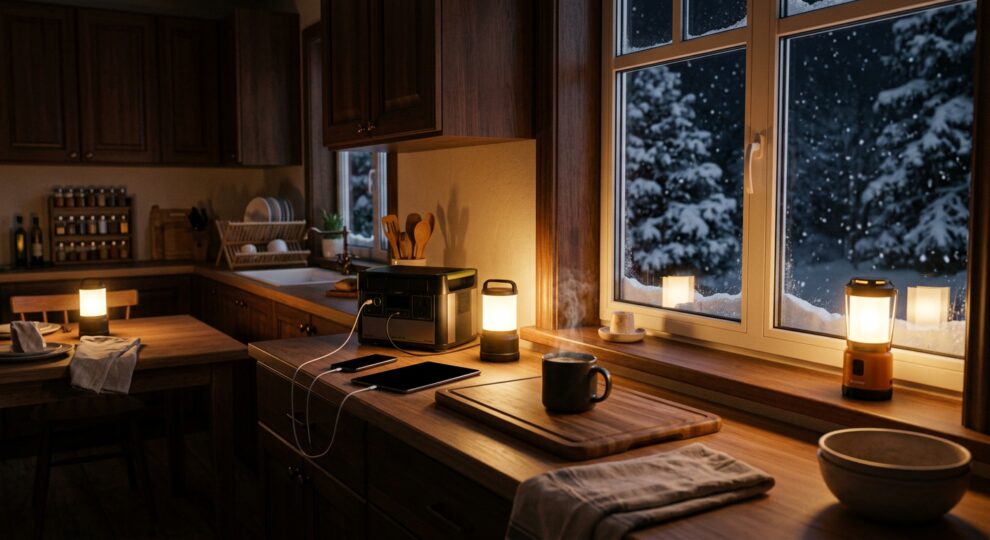
How to Prepare for a Winter Power Outage: A Complete Home Backup Guide
Affiliate disclosure: This post contains affiliate links. We may earn a commission if you make a purchase through our links, at no extra cost to you.
Winter power outages are different from any other kind of blackout. In summer, a dead refrigerator is an inconvenience. In winter, losing heat for 12 hours can turn your home into a genuinely dangerous place, especially for young children and older adults. Ice storms have knocked out power to millions of people for a week or more at a time, and the utilities that restore it fastest still take hours to reach everyone.
The good news: winter outage preparation is one of the most solvable problems in home preparedness. With a modest budget and an afternoon of planning, you can make sure that the next ice storm is boring instead of dangerous. This guide covers both sides of that equation: the planning steps that cost nothing, and the gear (from battery backups to safe heaters) that makes a real difference when the grid goes down.
What Actually Happens in a Winter Outage
Before buying anything, it helps to know what you are preparing for:
- Heat loss is the main threat. A well-insulated home loses indoor temperature slowly, often only a few degrees in the first several hours. The danger comes with extended outages (24+ hours) where indoor temps approach outdoor temps.
- Water pipes can freeze and burst when indoor temperatures drop below freezing, causing damage that lasts long after the lights come back on.
- Cell networks usually stay up but can degrade as backup batteries at towers drain over multi-day outages.
- Carbon monoxide is the silent killer of winter outages. Most CO deaths happen because someone brought a grill, generator, or gas camp stove indoors.
Your plan should keep you warm, keep pipes from freezing, keep you informed, and keep you alive. In roughly that order.
Step 1: Plan Around One Warm Room
Heating your whole house without the grid is expensive. Heating one room is cheap. Pick an interior room (fewer exterior walls means slower heat loss), ideally with a low ceiling if you have that option, and set it up as your “basecamp”:
- Block drafts with towels or foam weatherstripping
- Cover windows with blankets or reflective insulation at night
- Close doors to unused rooms
- Everyone sleeps in that room during the outage
A family of four sharing one room generates meaningful body heat on its own. Add proper cold-weather sleeping bags rated to at least 20°F and you can stay comfortable through surprisingly cold nights with no powered heat at all.
Step 2: Choose Your Backup Power Approach
There are three realistic options, and many well-prepared homes use two of them together:
Option A: Portable Power Station (Best for Most Homes)
A portable power station is a large rechargeable lithium battery with AC outlets, USB ports, and usually a 12V car socket. Compared to generators they are silent, emit no fumes, are safe to use indoors, require zero maintenance, and turn on instantly.
The tradeoff is capacity. Even a large station cannot run a central furnace for days. What it does brilliantly is run the essentials: phones, LED lights, a CPAP machine, a laptop, router/modem for information, and small appliances. Mid-size units can also run a pellet stove blower or a 12V blanket.
What to look for:
- Capacity in watt-hours (Wh): 300-500Wh covers phones and lights; 1000Wh+ adds a small fridge or CPAP for a night; 2000Wh+ handles most of a room’s needs for a day
- Pure sine wave output: required for sensitive electronics like CPAP machines and laptops
- Recharge options: wall outlet, car socket, and ideally solar panel input so you can extend runtime indefinitely in daylight
| Tier | Example Use Case | Typical Price |
|---|---|---|
| Budget (under $400) | Phones, lights, radio, recharges for 1-2 days | $200-$400 |
| Mid-range ($400-$900) | Adds CPAP, laptop, small fridge cycling | $500-$800 |
| Premium ($900+) | Room-level backup for 1-2 days, expandable with solar | $1,000-$2,500 |
Budget picks start under $100 for phone-and-lights duty; these tiers reflect what most households should plan to spend.
| Power Station | Capacity / Output | Price | Rating | Link |
|---|---|---|---|---|
| HOWEASY Portable Power Station 135W (270W Peak) Solar Generator | ~88-296Wh (phones, lights) | $97 | 4.3* | Check Price |
| 2400W Portable Power Station 1843.2Wh Solar Generator H | ~1,843Wh (fridge, CPAP, room essentials) | Check price | 4.3* | Check Price |
| Enphase IQ PowerPack 1500 Wh Portable Power Station | ~1,500Wh+ premium build | $1,513 | 4.7* | Check Price |
Option B: Fuel-Burning Generators (Best for Extended Outages)
For multi-day outages, a fuel-burning generator is still king. Modern inverter generators produce clean power safe for electronics, and dual-fuel models run on either gasoline or propane. One honest note: the large-output home backup models featured below are conventional (non-inverter) units chosen for whole-house wattage, and our top pick is actually tri-fuel, adding natural gas to gasoline and propane. Propane matters in winter: gasoline goes stale and gets hard to store safely in quantity, while propane stores indefinitely and runs cleaner in the cold.
Non-negotiable safety rules:
- Never run a generator indoors, in a garage, or within 20 feet of any window or vent. Generators kill more people through carbon monoxide than fires do.
- Store fuel away from living spaces.
-
Exercise the generator monthly so it starts when needed.
-
Westinghouse 12500 Peak Watt Tri-Fuel Home Backup Portable Generator: Check price on Amazon
- DuroMax XP10000EH Dual Fuel Portable Generator – 10000 Watt Gas or Propane Powered: Check price on Amazon
- DuroMax XP13000HX 13000-Watt Dual Fuel Portable Generator – Gas & Propane: Check price on Amazon
Option C: Both (The Gold Standard)
The pattern experienced households converge on: a power station for quiet, instant, indoor-safe power for electronics and small loads, plus a generator (run outside, daytime only) to recharge the station and run high-draw items like a space heater or microwave. If budget allows only one, start with the power station; it solves more daily problems and has zero safety risk.
Step 3: Heat Safely Without Central Heat
This is where winter outages get genuinely risky, so read this section twice:
Safe to use indoors:
- Properly vented gas fireplaces and wood stoves
- Indoor-rated kerosene or propane heaters with tip-over shutoffs and low-oxygen sensors (use per manufacturer instructions, crack a window slightly)
- Electric blankets and 12V heated blankets run off a power station (extremely efficient, warm a person rather than a room)
- Sleeping bags, layered clothing, hats, and insulated pads under you (the ground steals heat faster than air does)
Never use indoors:
- Charcoal grills, hibachis (people die from this every single winter)
- Camp stoves intended for outdoor use, unless explicitly rated indoor-safe with CO monitoring
- Any generator, ever, inside or attached garage
Buy a battery-powered carbon monoxide detector before you buy any heater. It is the single highest-value purchase in winter preparedness. Also grab a few packs of chemical hand warmers: they cost almost nothing, last years, and are morale-savers for kids.
- Kidde battery-powered carbon monoxide detector: Check price on Amazon
- Hand warmers value pack (10 pairs): Check price on Amazon
Step 4: Protect Your Pipes
Frozen burst pipes cause thousands of dollars of damage and often knock out water for the whole house. When an outage hits and temperatures are below freezing:
- Open cabinet doors under sinks on exterior walls so warm room air reaches the pipes
- Let cold-water faucets farthest from the meter trickle slowly (moving water resists freezing)
- Know where your main water shutoff valve is before you need it
- If you leave the house during a deep freeze, set faucets to trickle and keep interior doors open
Foam pipe insulation costs a few dollars per foot and takes minutes to install. Doing it on a mild Saturday is far better than doing it by flashlight at 2 AM.
Step 5: Light, Information, and Communication
- LED lanterns beat flashlights for room lighting; one lantern per room plus headlamps for hands-free tasks covers most homes
- A NOAA weather radio (hand crank or battery) gives you forecast updates and emergency broadcasts when cell service degrades
- Keep phones in low-power mode and agree on a family check-in text routine to conserve battery
-
Write down important phone numbers; dead batteries plus a dead phone make it impossible to reach anyone
-
Etekcity LED camping lanterns (2-pack): Check price on Amazon
- FosPower NOAA weather radio: Check price on Amazon
Step 6: Food and Water for Cold-Weather Outages
Winter gives you one genuine advantage: outdoor temperatures become a freezer. Food in your refrigerator stays safe longer if you minimize door openings (a full fridge holds safe temperature about 4 hours; a full freezer about 48). Beyond that:
- Move refrigerated items into a cooler placed securely outdoors or in an unheated enclosed porch (watch for raccoons)
- Keep 3+ days of no-cook food on hand: canned soups and beans, peanut butter, crackers, dried fruit, granola bars
- Stock 1 gallon of water per person per day; municipal water usually keeps flowing in outages, but well pumps do not, and pipes can fail
- A camping stove used briefly near a cracked window (never indoors overnight) can heat soup and melt snow if needed
Quick Checklist: The Night Before a Forecast Ice Storm
- [ ] Charge all phones, laptops, and the power station to 100%
- [ ] Fill bathtub(s) with water for flushing toilets
- [ ] Test lanterns and put one in each main room
- [ ] Move cooler and shelf-stable food to easy-access spot
- [ ] Check generator oil and fuel; move it to its outdoor operating spot (not in the house)
- [ ] Set the thermostat a few degrees higher than normal so the house starts warm
- [ ] Confirm CO detectors have fresh batteries
- [ ] Locate flashlights, hand warmers, first aid kit, and blankets
FAQ
How long does a house stay warm without power?
A typical well-insulated house drops only a few degrees in the first 4-6 hours and may take 8-24+ hours to become dangerously cold, depending on outdoor temperature, wind, and insulation. That buffer is why early preparation matters: seal one room early and the house barely matters.
Is a portable power station worth it for outages?
For most families, yes. It is the only backup power source that is silent, fume-free, and safe to operate indoors. It will not run central heat, but it reliably covers phones, lights, medical devices, and information access, which are the things that actually determine whether an outage is manageable.
Can I run a generator in my garage with the door open?
No. Carbon monoxide builds up fast and seeps into the house even with the door open and fans running. Run it outside, at least 20 feet from the house, with exhaust pointed away from windows.
How much food and water should I store for winter?
Plan for at least 3 days per person: 1 gallon of water per person per day and roughly 2,000 calories per person per day of shelf-stable food. If winter storms are common where you live, extend to a week.
What temperature is too cold to stay in a house?
Once indoor temperatures fall below about 50°F, hypothermia risk becomes real for vulnerable people, and below 40°F pipes are at risk of freezing. If you cannot hold the line above those numbers with safe heating, relocate: to family, a warming center, or a hotel.
Do candles work for emergency lighting?
They work but are a leading cause of house fires during outages. Battery LED lanterns are brighter, safer, and last far longer per dollar. If you must use candles, never leave them unattended and keep them away from anything flammable.
Related Reading
- Tornado Preparedness: How to Stay Safe During Severe Weather
- Flood Emergency Plan: How to Prepare and Stay Safe
- A Civilian’s Guide to Emergency Communication
- Best Portable Generators for Emergency Power
External Resources
The Bottom Line
Winter outage prep is mostly about deciding before the storm: which room you will live in, how you will power it, and how you will keep it above 50 degrees safely. Start with the free steps (pick the room, seal drafts, make the checklist), add a battery-powered CO detector and LED lanterns this week, then save toward a mid-range power station sized to your essentials. Do that and the next ice storm becomes a story instead of an emergency.