Best Portable Camping Stoves for Emergency Cooking
Affiliate disclosure: This post contains affiliate links. We may earn a commission if you make a purchase through our links, at no extra cost to you.
When the power goes out, the stove is usually the first appliance to fail and the last one people plan for. Electric cooktops die instantly with the grid. Gas stoves often keep working, unless the outage is big enough that the utility shuts gas off, or the ignition is electric and nobody owns a match. And an electric pressure cooker, the daily workhorse in many kitchens, is dead weight in a blackout. A portable camping stove turns “no cooking for three days” into “business as usual,” for less than the cost of a single delivery dinner.
The good news: this is one of the most mature categories in outdoor gear. The stoves below are proven designs with tens of thousands of reviews, decades of production history in some cases, and fuel that is cheap and easy to store. The important nuance is indoor versus outdoor use, and we will be direct about it: butane and propane stoves are for well-ventilated spaces, and the safest habit is outdoor cooking on a porch or balcony. We will cover how to do that well and what the safe-indoor options look like.
Here are our picks, followed by how to choose fuel, where to cook safely, and how much stove your household actually needs.
Quick Picks: Best Emergency Camping Stoves
| Pick | Product | Best For | Rating | Price | Link |
|---|---|---|---|---|---|
| Best Overall | Gas One GS-3400P Dual Fuel | Households (butane + propane) | 4.6 | ~$30 | Check Price on Amazon |
| Best Propane | Coleman Bottletop Propane Stove | Reliability, any weather | 4.7 | ~$40 | Check Price on Amazon |
| Best Budget/Backpacking | AOTU Portable Backpacking Stove | Go-bags, ultralight kits | 4.5 | ~$10 | Check Price on Amazon |
| Best Alcohol-Free Simple | Coghlan’s Folding Camp Stove | Rugged simplicity, plate cooking | 4.5 | ~$33 | Check Price on Amazon |
| Best Ultralight | BRS-3000T Titanium Stove | Minimalist kits, 25 grams | 4.5 | ~$17 | Check Price on Amazon |
| Best with Case | Gas One Butane Stove with Case | Storage, one-burner kitchen | 4.6 | ~$33 | Check Price on Amazon |
How We Chose
An emergency stove has different priorities than a backpacking stove, and the overlap is where the best picks live. We evaluated:
Fuel availability and shelf life. Butane canisters and 1-pound propane bottles are inexpensive, sold everywhere from grocery stores to big-box hardware, and store safely for years in a garage. We prioritized stoves that run on these common formats.
Ignition reliability. Piezo ignition works when batteries do not, and a stove that also takes a literal match is the redundancy you want in a kit.
Real output, honest boil times. An 8,000 BTU burner boils a liter in about 4 minutes; that is plenty for real cooking. Marketing numbers above 15,000 BTU on tiny stoves matter less than wind performance and simmer control.
Stability and build. A stove that holds a full pot steady on a porch table is a safety feature. We weighted wide burners, solid pot supports, and build quality with long track records.
Track record. Every pick has thousands of ratings at 4.5 stars or better; the leaders have decades of use behind the design.
The Top Picks
1. Gas One GS-3400P Dual Fuel Stove: Best Overall
The short version: runs on both butane canisters and 1-pound propane bottles, which means your fuel options double exactly when flexibility matters most.
Key specs
- Dual fuel: 8oz butane canisters or 1-pound propane bottles
- 8,000 BTU burner with piezo ignition
- Carrying case, brass burner head
- 4.6 stars from more than 15,000 ratings
Where it shines. This is the emergency stove logic in its purest form: two fuel paths, one burner. Butane canisters are cheap, compact, and work well in mild weather; propane bottles handle cold and store indefinitely. A household that keeps a few of each is effectively immune to the “the store is out of one fuel” problem that hits before storms. The GS-3400P lights with a click, holds a pot steady, and simmers well enough for real cooking, not just boiling. For a first emergency stove, this is the answer for most homes.
Where it falls short. It is a single burner, so full family cooking means sequencing pots. The included case is basic. And like all butane/propane stoves, it is a ventilated-space tool: porch and balcony cooking, never a sealed kitchen with windows shut.
Best for: any household starting from zero. Buy this one first.
2. Coleman Bottletop Propane Stove: Best Propane
The short version: the classic screw-on-propane-bottle design that has worked through decades of storms, with the best cold-weather behavior in the group.
Key specs
- 7,650 BTU burner, screws directly onto 16.4oz propane bottles
- Wind-block burner design, perfect-heat adjustability
- Weight about 1 pound, packs small
- 4.7 stars from more than 7,000 ratings
Where it shines. Coleman has built this pattern of stove for decades, and the design survives because it is nearly fail-proof: screw on a propane bottle, open the valve, light with the match you taped to the bottle. Propane outperforms butane in cold weather, which matters for winter outages and shoulder-season camping. The bottletop format means no hoses, no regulators, and nothing to break: the bottle is the stand. For a car kit or a cabin, this is the stove that starts every single time.
Where it falls short. The bottletop design puts the bottle in the structure, so pot stability is adequate rather than rock-solid with large pots; keep cookware modest. Single-burner, like most here. And the minimalist build means no built-in ignition on many versions: keep matches or a lighter in the kit.
Best for: winter kits, car emergency boxes, and anyone who values decades-proven simplicity.
3. AOTU Portable Backpacking Stove: Best Budget
The short version: a pocket-size piezo stove at an impulse-buy price, ideal for every go-bag and the junk drawer.
Key specs
- ~3,500W class output on isobutane/propane canisters
- Folding pot supports, weighs about 4 ounces
- Wind-collecting burner design
- 4.5 stars from more than 6,500 ratings
Where it shines. At around the price of a pizza, this stove belongs in every bug-out bag, car kit, and camping bin. It screws onto standard isobutane canisters, lights with a click, boils water fast for its size, and collapses smaller than a coffee mug. The emergency value is coverage: like the first aid article’s budget pick, the low price means you can put one everywhere it might be needed.
Where it falls short. Small burners and narrow pot supports want small pots and sheltered spots; this is a boil-and-simmer tool, not a fry-everything station. Canister fuel (isobutane blends) sputters in near-freezing weather. And the ultra-budget build is fine but not heirloom: check the piezo still clicks twice a year.
Best for: go-bags, gloveboxes, students, and as a backup to your main stove.
4. Coghlan’s Folding Camp Stove: Best Rugged Simple
The short version: a steel plate-top stove built like a piece of shop equipment, happiest burning solid fuel or holding a kettle steady.
Key specs
- Folding steel stove top, burns hexamine/solid fuel tablets
- Flat plate top supports kettles and pots of many sizes
- Weighs under 1 pound, folds flat for storage
- 4.5 stars from more than 5,700 ratings
Where it shines. Sometimes the answer is a steel plate that folds out and burns anything you put under it. The Coghlan’s design has been a scout kit and emergency-bin fixture for decades: no pressurized fuel, no valves, no canister shelf life anxiety, just fuel tablets (or twigs in a pinch, managed carefully) and a stable steel plate that holds anything you set on it. As a companion to a butane stove, it covers the what-if-the-fuel-runs-out case with an entirely independent fuel path.
Where it falls short. Solid fuel tablets are slower and weaker than gas: heating soup and boiling water, not searing steaks. The plate needs a heat-proof surface underneath and patience. This is a backup’s backup, which is exactly its job.
Best for: emergency bins as the no-pressure-fuel fallback, scout kits, and minimalist boil-and-heat cooking.
5. BRS-3000T Titanium Stove: Best Ultralight
The short version: 25 grams of titanium that boils water with almost no fuel, the ultralight champion for bags where every ounce is counted.
Key specs
- Titanium construction, about 25 grams total weight
- ~3,000W output on isobutane/propane canisters
- Folds to fit inside a small tin
- 4.5 stars from more than 3,900 ratings
Where it shines. The BRS-3000T is famous in ultralight circles for one reason: it disappears in a pack and still boils water efficiently. In a go-bag built around weight and space, that is exactly the stove you want. Titanium shrugs off corrosion, so a stove forgotten in a car kit for years still works. Paired with a 110g canister and a titanium pot, it is a complete boiling station lighter than a water bottle.
Where it falls short. The featherweight build is a trade: thin titanium arms and a low profile want careful pot placement and wind protection. Like all canister-top stoves, cold weather hurts performance. And it is strictly a one-small-pot stove; family-scale cooking is out of scope.
Best for: ultralight bug-out bags, motorcycle and kayak kits, and minimalist travelers.
6. Gas One Butane Stove with Case: Best One-Burner Kitchen
The short version: a full-size butane burner in a hard carry case, the closest thing to dropping a working stove on your counter or porch table.
Key specs
- Single-burner butane stove, ~8,000 BTU class
- Automatic piezo ignition, precise heat control, wind guard
- Hard carry case, brass burner
- 4.6 stars from nearly 3,000 ratings
Where it shines. This is the stove that hotspot restaurants use as table burners, which tells you about its build: a real cooking platform with a wind guard, precise simmer control, and a stable base for full-size pots. In an outage it becomes the kitchen: one burner, sequenced like a cooking show, on a porch table. The hard case keeps it clean in storage and makes it grabbable in the dark. If your outage plan is “cook real meals for a family,” this and a stack of butane canisters is the setup.
Where it falls short. Bigger and heavier than everything else here; this is the car-trunk or pantry-shelf stove, not a pack item. Butane only, so cold weather saps performance (the dual-fuel GS-3400P covers that gap). And butane canisters vanish from stores first before storms, so stock early and rotate.
Best for: family outage cooking, tailgates, and a one-burner kitchen anywhere there is ventilation.
Cooking Safely During an Outage
The one rule that matters: ventilation. Butane and propane stoves consume oxygen and produce carbon monoxide. Use them outdoors (porch, balcony, driveway) or in large, well-ventilated spaces with a window open, never in a sealed room, tent, or vehicle with the windows up. A carbon monoxide alarm in the house is cheap insurance in any emergency plan.
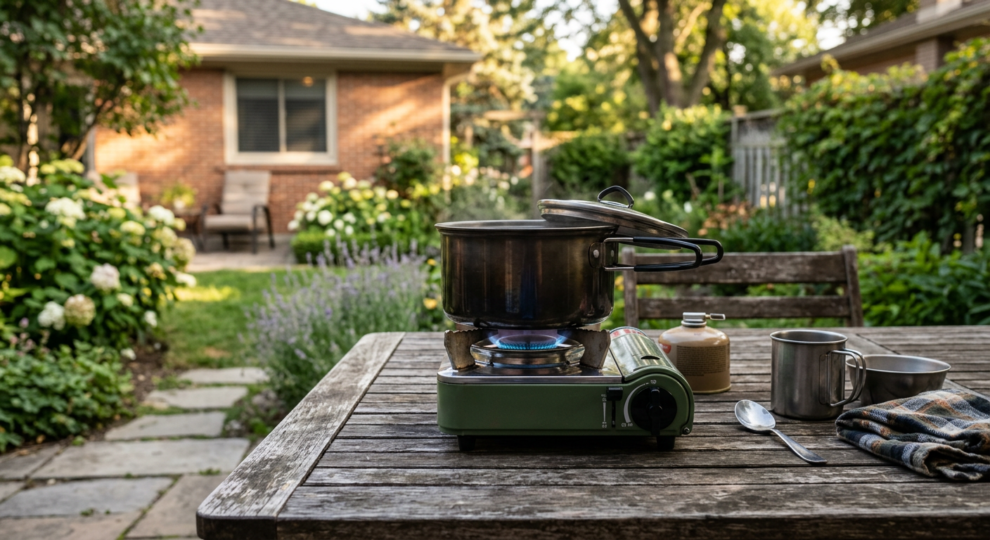
Cook outside whenever weather allows. A folding table on the porch turns any of these stoves into a full outdoor kitchen. Rain gear in the kit keeps the chef willing.
Stock fuel deliberately. Plan roughly one butane canister per day of family cooking, or a 1-pound propane bottle every 2 to 3 days. Store canisters away from heat, check dates yearly, and rotate: use them on camping trips and buy fresh.
Water first. In any outage, the cooking priority is safe water and hot meals, not variety. Boiling is the most reliable water treatment, which makes your stove a water-purification tool too. The EPA and Ready.gov both list boiling among recommended methods in their emergency water guidance.
Practice one full meal before you need it. Set the stove on the porch table, cook a complete pasta dinner from pantry supplies, and time how much fuel it takes. That single practice run tells you your real fuel consumption per meal, whether your pot and utensils work on the burner, and where the wind comes from at your house. It also converts the stove from a box in the pantry into a skill the whole family trusts; during an actual outage, the person who practiced cooks while everyone else watches with admiration.
For the full outage picture, pair this guide with winter power outage preparation, stockpiling food and water, and our food storage kit comparison. For stove-specific carbon monoxide guidance, the CDC’s CO page is the authoritative reference.
Emergency Stove FAQ
Can you use a camping stove indoors during a power outage?
Only with real ventilation, and the safest answer is “use it outside.” Butane and propane stoves emit carbon monoxide and consume oxygen; brief use near an open window is a calculated risk some households take in hard weather, but sealed-room use is dangerous, period. Solid-fuel stoves like the Coghlan’s are for outdoor use as well.
Butane or propane for emergency storage?
Both, ideally. Butane is cheap, compact, and great in mild weather; propane handles cold, stores indefinitely, and bottles are sold everywhere. A dual-fuel stove (our top pick) takes either, which is why it wins for households.
How much fuel should I store for emergencies?
For a family cooking one hot meal a day: roughly one butane canister or a quarter of a 1-pound propane bottle per day, so a week of outages means 7 to 10 butane canisters or 3 propane bottles. Round up and rotate stock yearly.
Are camping stoves allowed in apartments?
Balcony and porch use is usually the intended pattern; check your lease and local fire code for restrictions on open flame and fuel storage quantities. Many jurisdictions cap stored canisters (often 2 to 4) for residential units.
What cookware works on portable stoves?
Any standard pot or kettle works on the wide burners (Gas One, Coleman, the full-size butane stoves). Narrow canister-top stoves want pots under 1.5 liters. One 2-liter pot with a lid covers nearly all emergency cooking.
How long does a butane canister last?
A standard 8oz canister holds about 10,600 BTU of energy, so a full-power 8,000 BTU burner drains it in roughly 75 to 80 minutes; at everyday cooking power it runs noticeably longer. Light use (coffee, boiling water) stretches a canister across 3 to 5 days; cooking full family meals uses closer to one canister per day.
The Bottom Line
Start with the Gas One GS-3400P around $30, add a stack of butane canisters and a couple of 1-pound propane bottles, and your household can cook through any outage on the porch like it is a barbecue. Winter-prep homes should add the Coleman bottletop stove around $40, and every go-bag deserves the AOTU around $10. The whole plan costs less than one food delivery order.
Buy the stove, buy the fuel, cook one meal on the porch this month to learn the ropes, and a power outage loses its scariest question: what’s for dinner?