Affiliate disclosure: This post contains affiliate links. We may earn a commission if you make a purchase through our links, at no extra cost to you.
Preparing your car for an emergency evacuation comes down to three things: a vehicle that will start and run, a kit organized by category, and a route plan your family actually knows. This bug out vehicle checklist walks through all three, in the order that matters. You do not need a tricked-out off-roader. A well-maintained sedan with a thoughtfully packed trunk beats a neglected SUV every time, because in most evacuations the winning move is simply leaving early and keeping driving.
Most families already own the most expensive piece of survival gear they will ever need: the car in the driveway. Treat it that way, and the rest of this list becomes a series of small, affordable additions.
| Product | Best For | Why It Earns a Spot |
|---|---|---|
| Sawyer Squeeze Water Filter | Clean water from any clear stream | Screws onto a standard bottle and filters as you squeeze, so one filter stretches your whole water supply. |
| LifeStraw Personal Water Filter | A no-fuss backup | Drink straight from the source if your main filter is lost, clogged, or left at home. |
| Emergency Sleeping Bags (2 Pack) | Warmth for two, in a small pouch | A sleeping bag shape traps heat better than a flat blanket and packs down to nearly nothing. |
| Survival Frog Tact Bivvy 2.0 | Cold snaps and winter routes | A reflective bivy sack that holds body heat and stuffs into a sack the size of a fist. |
| BLAVOR 20000mAh Solar Power Bank | Keeping phones charged on a long drive | Big enough to top up several phones, with a solar panel for slow trickle charging while parked. |
| TrixHub Rechargeable Flashlights (2-Pack) | One light for each front seat | Two USB rechargeable lights mean a dead battery in one never leaves you in the dark. |
Your Bug Out Vehicle Checklist Starts Under the Hood
Gear cannot rescue a car that will not run, so maintenance sits at the top of the list. Ready.gov’s vehicle guidance makes the same point: a maintained vehicle with a stocked kit is the goal. These are the habits that matter:
- The half tank rule: Refuel at half a tank, always. Most evacuations happen with little warning, and gas stations near an evacuating area run dry or lose power quickly. Half a tank gives most cars a 150 to 200 mile cushion without a stop.
- Battery: Most batteries die at the three to five year mark. Have yours tested at every oil change, and replace it on your schedule rather than a parking lot’s.
- Tires, including the spare: Check pressure monthly, since cold mornings drop it noticeably. Once a season, pull the spare and confirm it holds air and that the jack and lug wrench are actually in the car.
- Fluids and wipers: Oil, coolant, brake fluid, and washer fluid top the list. Streaking wipers are a ten dollar fix that doubles what you can see in a storm.
One more habit: know your car’s real range. Fill up, note the miles driven when the gauge reaches half, and write that number in your glovebox. In an evacuation, range is a planning number, not a guess.
Power: Jump Starting, Charging, and Light
A dead battery is the most likely reason a car fails its owner in a crisis, so power comes first in the loadout. A compact lithium jump starter has replaced jumper cables for most drivers: no second car needed, and most units double as phone chargers. Look for one rated well above your engine size, with clamps that spark less if you touch them in the wrong order, and recharge it every couple of months because these units slowly self discharge. If you prefer keeping it old school, heavy jumper cables work, but they require a helpful second vehicle, which you may not find at 3 a.m.
For everything else that runs on a battery, a BLAVOR 20000mAh solar power bank covers phones, and a two pack of rechargeable flashlights covers light. Keep one flashlight in the glovebox and one in the door pocket so a passenger never has to dig. Be honest about solar panels on power banks: they are a trickle backup, not a recharge plan. USB from the car or a wall outlet does the real work, and the panel is there for a long stop in the sun.
If you have room for one more item in this category, make it a hand crank emergency radio. A FosPower NOAA hand crank radio receives weather broadcasts, works as a flashlight, and tops up a phone without any grid power at all, which matters the moment you leave broadcast coverage and need to know what is ahead.
Water: Let a Filter Do the Heavy Lifting
The standard planning number is one gallon of water per person per day, and a family of four leaving for three days faces twelve gallons. That is a load of groceries in weight, and it is why a filter changes the math. Bottled water covers the first day, and a filter covers everything after, because evacuation routes and destinations usually pass creeks, lakes, and spigots.
The Sawyer Squeeze water filter is the workhorse pick: it screws onto a standard water or soda bottle, filters as you squeeze, and can be backwashed to restore flow. Its one real rule is temperature. Hollow fiber filters are damaged by freezing, so the filter rides inside the cabin in winter, never in a trunk that drops below freezing. A LifeStraw personal filter makes a smart second string, since it weighs almost nothing and needs no bottle at all. We compared the two head to head in our Sawyer Squeeze vs LifeStraw breakdown if you want the details.
Rotate the bottled water in your kit every six months. Heat cycles in a parked car work on the plastic, and fresh bottles cost little. Mark the rotation date on the cap with a marker and the habit takes care of itself.
Warmth: Emergency Sleeping Bags That Live in the Trunk
Warmth gear earns its spot the first time a road closes at night in January, or an evacuation strands you in a parking lot with sleeping children. Mylar space blankets fold flat, but they are crinkly, tear easily, and do little under a restless sleeper. Emergency sleeping bags hold heat the way a real bag does, and they cost little enough to just leave in the car permanently.
A two pack of emergency sleeping bags covers two family members, and they double as ground cloths or wind shields in a pinch. They are sized snug, so side sleepers should know comfort is not the selling point, staying warm is. For deeper cold, a Survival Frog Tact Bivvy 2.0 adds a reflective layer that bounces body heat back at the sleeper and packs into a small stuff sack. Expect some condensation inside any reflective bivy; that is normal, and a wool beanie and dry socks solve the part that actually matters.
If your winters are real winters, add a folded wool blanket and an insulated change of clothes per person from fall through spring, then swap them out in April. Seasonal kit swaps take ten minutes twice a year and are the difference between gear that fits the weather and gear that does not.
Tools and Traction: Fix the Small Stuff Before It Strands You
This category is about self sufficiency for the problems that actually stop a car. Nothing here needs to be exotic:
- Flat repair: A 12 volt tire inflator seals the gap between a slow leak and the next gas station, and a tire plug kit handles the nail itself. Check your inflator twice a year so the compressor still works when called on.
- Jump starting: Covered above, but if you carry cables, carry the longest pair you can find. Sometimes the helpful stranger cannot park close.
- Basic tools: A small tool roll with screwdrivers, pliers, adjustable wrench, and the socket size for your lug nuts, plus duct tape and zip ties. Most roadside failures you can fix are held together by exactly those three things.
- Traction and recovery: A short tow strap rated for your vehicle’s weight, a folding shovel, and a bag of clay kitty litter for ice and soft shoulder mud.
- A heavy duty tarp: The most versatile item in the trunk. It is a rain shelter, a ground cloth, a way to drag a cooler of supplies, and a privacy screen for a roadside change of clothes.
- Work gloves and a headlamp: Cold hands fumble, and you cannot hold a flashlight and turn a lug wrench at the same time.
Then learn the two jobs that solve most roadside problems: changing your own tire, and jump starting safely. Twenty minutes in the driveway with the owner’s manual open is worth more than any tool you will never use.
Navigation and Documents: Paper Works When Screens Die
Phones fail in exactly the ways that hurt during an evacuation: dead batteries, overloaded towers, and no signal in a river valley. Keep a folded road atlas of your state in the door pocket, plus a basic compass. Neither needs a charge, and both work at 2 a.m. when the interstate is closed and the detour is not signed.
Documents go in a zip pouch in the glovebox: copies of insurance cards, registration, a photo ID for each adult, contact numbers written on paper, and about two hundred dollars in small bills. Card readers and ATMs go down together, and cash settles a hotel room or a tank of gas when the network will not. Photograph the originals too, stored where you keep family photos, so a lost wallet never becomes a lost identity. When the family spreads across two cars, a paper list of who is in which vehicle and a written rally point beats any group chat, and our family emergency plan guide covers how to set those meeting points up.
Packing Order: Load the Trunk So It Works Under Stress
A packed kit you cannot reach is theater. Pack in this order and the system holds up even when hands are shaking:
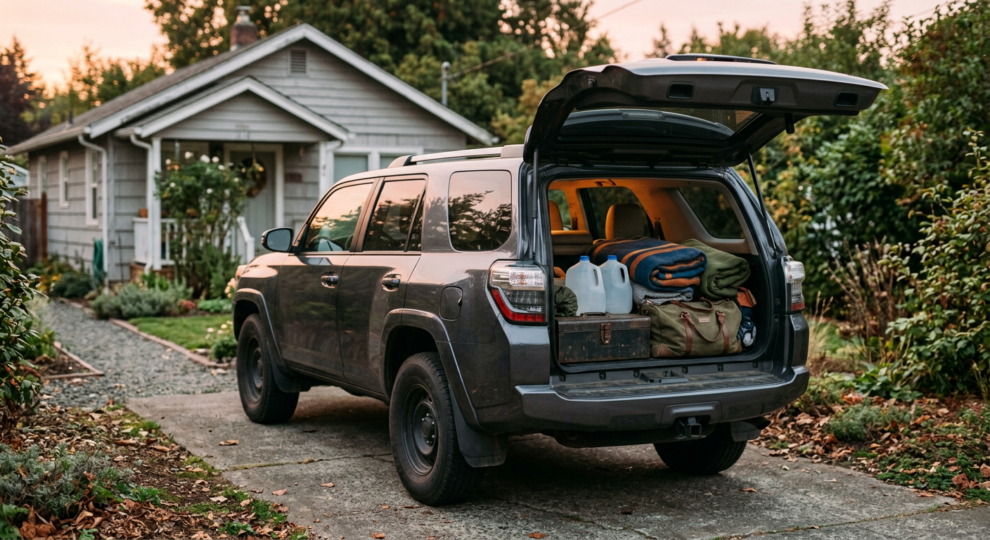
- Lowest and heaviest: Water, tools, traction gear, and the tarp ride at the bottom, against the rear seatbacks so they cannot become projectiles in a hard stop.
- One duffel per person: Clothing, sleeping bag, and hygiene items in separate bags, so one person can grab their own bag without unloading the trunk.
- Cabin essentials: Water bottles, flashlight, phone bank, documents pouch, and any medications ride inside the passenger area, never the trunk. If the road forces you to leave the car in a hurry, you take the cabin, not the cargo.
- Labeled bins: One bin for warmth, one for tools, one for food. Labels are for the neighbor who is driving your kids out while you stay behind to shut off the gas.
Perishables and heat are the two enemies of a packed car. Food should be calorie dense and heat stable, like granola bars, nut butter packets, and jerky, rotated on the same twice a year schedule as your water. Electronics and spare batteries live in the cabin where temperatures swing less. For the grab-and-go side of this, our guide to essential bug out bag gear covers what each person carries on their back once the car is packed.
Route Thinking: Three Ways Out of Town
An evacuation route is not a line on a map, it is a decision tree. Build yours in three layers:
- Primary: The interstate or main highway. Fastest in ordinary conditions and everyone else’s first choice too, which is exactly the problem. Know its choke points by name: the bridge, the tunnel, the two-lane stretch.
- Secondary: State and county roads that run roughly parallel. Slower, but a jam on the interstate does not touch them. Drive this route once for real, because paper knowledge of which road is paved and which gate is locked fades fast.
- Third option: The back way home from an errand, the gravel road you have wondered about. This route is for gridlock, not for off-roading, so confirm it accepts a sedan.
Attach numbers to each route: miles, and fuel needed based on your car’s real range. Attach people too. Set two rally points, one close to home and one out of the region, and write both on the document card in the glovebox. The official line on all of this, from Ready.gov’s evacuation planning guidance, is simple and worth adopting: know where you will go, agree on it as a family, and leave early when officials say to move. The single biggest factor in evacuation driving is not the vehicle. It is departure time, and a full tank the night before a forecast storm is the cheapest insurance on this whole page.
Bug Out Vehicle Checklist FAQ
How much water should I keep in the car?
Plan on one gallon per person per day as the baseline, but you do not need all of it in plastic. A case of small bottles for the first day plus a squeeze filter covers the rest, since a filter turns any clear creek or spigot into a resupply. Rotate the bottles every six months, because heat cycles in a parked car degrade both the water taste and the plastic.
How often should I run through this checklist?
Twice a year for the full pass, in spring and fall, paired with the seasonal gear swap. Once a month, take five minutes: tires, fuel level, and a glance at the trunk bins. The fuel habit matters most between checks, so tie refueling at half a tank to payday or any other date you never miss.
Do I need four wheel drive or a big SUV?
No. Most evacuations are traffic problems, not off-road problems, and a well-maintained sedan with a full tank outperforms a neglected SUV in every scenario that involves pavement. What matters is ground clearance you know, tires with tread, and leaving before the roads jam. If your routes cross real winter or flood country, spend the money on tires and maintenance before considering a different vehicle.
Where should the kit live if I park outside or share the car?
One bin or duffel per person that moves in and out with the family solves both problems. In extreme heat or cold, bring temperature sensitive items inside and leave the hardy gear in place. Shared cars work fine with this system too, since labeled bins mean whoever has the car that day can see in thirty seconds whether the kit is aboard.