Affiliate disclosure: This post contains affiliate links. We may earn a commission if you make a purchase through our links, at no extra cost to you.
What Emergency Preparedness for Seniors Really Means
Emergency preparedness for seniors is not a harder version of family prepping. It is the same goal organized around six realities most general guides skip: a medication supply with a cold storage plan, mobility and evacuation help, backup power for medical equipment, communication that survives dead batteries and jammed networks, a personal support network, and documents you can reach quickly. Cover those six and a storm or an outage becomes a problem you have already solved on paper.
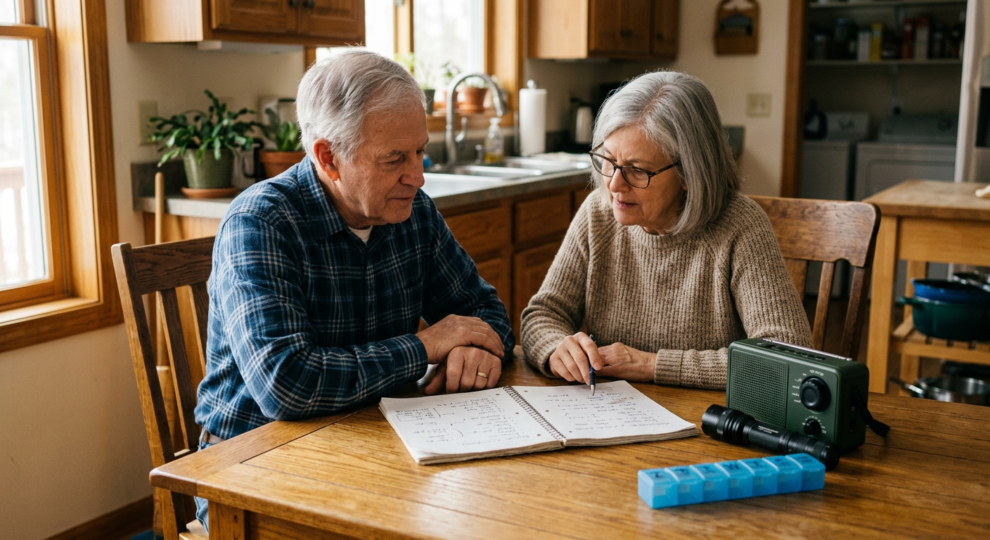
This guide is written for two readers: older adults running their own planning, and adult children helping a parent without taking over. Most families can finish the core steps in a weekend or two, and none of it requires special skills or a large budget.
Start with an honest inventory of everything you or your parent depends on in a normal day: prescriptions, refrigerated medicine, a walker or wheelchair, glasses, hearing aids, a CPAP machine, an oxygen concentrator, a ride to the pharmacy. Your emergency plan only has to protect what you actually use, so this list decides where your attention and money go. The senior checklist on ready.gov is a useful cross-check once it is written.
A few items earn their spot early:
| Product | Best For | Why It Earns a Spot |
|---|---|---|
| AUVON Weekly Pill Organizer | Weekly doses with stiff or painful hands | Spring-open lids need almost no grip strength to load |
| Midland ER310 Emergency Radio | Warnings when power and cell service fail | Hand crank and solar charging with NOAA weather bands |
| BLAVOR Solar Power Bank | Keeping a phone alive through a multi-day outage | 20,000 mAh refills a phone several times, with a solar panel as backup |
| Check Price on Amazon | Light you can find instantly in the dark | A rechargeable emergency light that stays ready between outages |
Medication Supply and Cold Storage Come First
Prescriptions are the supply seniors run out of first, so build the buffer deliberately. Ask your pharmacist two questions: how early you can refill, and whether your plan allows an emergency refill during a declared disaster. Many insurers cover an early refill when a storm is on the way, and some states require it. Refill on the first eligible day, every time, and you drift into a one to two week cushion without spending extra.
Cold storage is the part people miss. Insulin and several other medicines must stay refrigerated, generally between 36 and 46 degrees Fahrenheit, so ask your pharmacist what yours specifically needs. For an outage that means a cooler, ice packs in the freezer, and a rule: keep the refrigerator door closed, move medicine only if the house warms past the safe range, and know in advance which nearby relative or neighbor has a generator or a working fridge. A small refrigerator thermometer removes the guesswork.
For the daily routine, a pill organizer keeps doses straight when a disrupted schedule makes memory unreliable. The AUVON Weekly Pill Organizer has spring-open lids made for arthritic hands, and the Amazon Basic Care AM/PM Pill Organizer splits morning and evening doses into large, easy-to-load compartments. Be honest about the limit: an organizer holds seven days, not a month. Its job is schedule discipline while the real cushion sits in labeled bottles, which is what you carry when you evacuate.
Keep a written medication list in three places: wallet, go-bag, and taped inside a kitchen cabinet. Drug names, doses, timing, allergies, prescriber, and pharmacy number, printed large enough to read without hunting for glasses.
Power-Dependent Medical Equipment Needs a Backup Plan
Oxygen concentrators, CPAP machines, power wheelchairs, stair lifts, and home dialysis all stop when the grid does, so each device needs its own answer. Call the equipment supplier and ask what backup they offer: oxygen users can usually keep spare tanks on hand, CPAP users can ask about a battery made for their machine, and wheelchair users should learn the manual release for the brakes. Make these calls before an outage, not during one.
Then call your electric utility and ask about its medical needs registry. Most utilities keep a list of customers who depend on powered medical equipment, which can mean advance notice of planned shutoffs and priority attention when crews restore service. The call takes five minutes, and it works better if your adult child sits in.
A power bank covers the small devices that matter most: the phone you would call for help with, a lamp, a tablet. It cannot cross one line. The BLAVOR Solar Power Bank holds 20,000 mAh, enough to refill a phone several times, but an oxygen concentrator draws far more power than any portable bank can supply, so oxygen users lean on backup tanks instead. Recharge the bank monthly so it is full on the day you need it.
Prepare Your Home and Mobility for Evacuation
Most senior injuries in a disaster happen inside the house, usually a fall in the dark. Clear the paths between bedroom, bathroom, and kitchen, pull up loose rugs, move cords out of walkways, and add grab bars where you naturally steady yourself. Keep a light within reach of the bed and your favorite chair: a rechargeable emergency light left plugged in stays ready to grab, and a spare flashlight belongs in the go-bag. We compare models in our guide to the best emergency lights for power outages. Test smoke and carbon monoxide detectors monthly, and keep a fire extinguisher near the kitchen exit where you can lift it.
Stage your mobility aids before you need them. Walker within arm’s reach of the bed, wheelchair plugged in nightly, spare cane tip in the drawer, hearing aid batteries and a spare pair of glasses in the kit. If you use a power chair, write down its weight and whether it folds; whoever helps you evacuate will need that fast.
Pack a go-bag for at least three days and keep it by the door: labeled medicine bottles, document copies, glasses, chargers, water and shelf-stable snacks, and a few comfort items. Choose a bag with wheels if lifting is a problem, and keep it where a helper can grab it. If you cannot drive, the bag only matters if the ride exists: name two or three people who have agreed to come, and ask your county emergency management office about paratransit and any voluntary evacuation registry for residents who need help leaving. Our emergency evacuation plan field guide covers routes and timing in detail.
Communication When Phones and Power Fail
Cell networks jam or lose power in exactly the events you need them, so set your default now: text instead of call. Texts slip through congestion that blocks voice calls, and they need almost no battery. Pick one out-of-area contact everyone texts to check in, and carry the same numbers on a written card in your wallet and go-bag, printed large.
For news and weather warnings, a hand crank radio works when everything else is dark. The Midland ER310 runs on a hand crank or its solar panel, receives NOAA weather bands, and includes a flashlight. Practice tuning it once while life is calm; learning the dial during a warning is a bad time to start.
If you wear a medical alert pendant, confirm how long its battery backup lasts without house power and whether it works away from home. Better to learn that in advance.
Build a Personal Support Network
One reliable neighbor is worth more than any gadget. Choose two or three people and make the ask directly: exchange keys, show them where your medication list and documents live, and agree on a trigger, such as “if I do not answer by noon, come check on me.” Exchange numbers with your adult children on both sides. None of this gives up independence; it is how independence survives a bad week.
Widen the circle beyond close friends. A faith community, a senior center, a home health agency, or a local CERT team can fill gaps when your first calls are unavailable. Some counties keep voluntary registries of residents who would need help evacuating; one call to emergency management tells you whether yours does. Adult children: your highest-value jobs are being the out-of-area contact, holding a copy of the documents, and walking through the plan twice a year.
Organize Documents Before You Need Them
Emergencies come with paperwork: proof of identity for shelters and pharmacies, insurance details for a damaged home, medical information for a new doctor. Gather copies of photo ID, Medicare and insurance cards, the medication list, powers of attorney, advance directives, your insurance policy, and your deed or lease. Keep the copies in one waterproof folder everyone can describe in a sentence, such as the blue folder on the hall closet shelf. Store a second set with your out-of-area contact, plus a little cash in small bills, since card readers fail exactly when you need them.
You do not need to carry originals when you evacuate, but write their location on the front of the folder so a helper can find them in thirty seconds.
A One-Page Plan Beats a Perfect Plan
Everything above compresses onto one page: contacts and the out-of-area check-in, your meeting spot, where the medication cushion and documents live, backup steps for each powered device, and who checks on you and when. Post one copy on the refrigerator, one in the go-bag, and send one to each person in your support network. Our guide to building a family emergency plan covers the family-wide version if you are coordinating several households.
Then make it a habit instead of a project. Twice a year, walk the route from bedroom to door with the bag, recharge the bank and lanterns, rotate water and snacks, and count the medication cushion. Fifteen minutes, twice a year, turns a plan into muscle memory.
FAQ: Emergency Preparedness for Seniors
How much extra medication should a senior keep on hand?
Two weeks is a reasonable minimum, and a month is better where your prescriber and insurance allow it. Refill on the first eligible day, ask about emergency refills when a disaster is declared, and store the cushion in original labeled bottles. Never stretch doses without talking to your prescriber first.
What should I do during an outage if I use an oxygen concentrator?
Switch to your backup tanks, and call your equipment supplier if the outage looks like it will last. If tanks are limited and an extended outage is forecast, relocate early to family or a shelter that can support power needs instead of waiting for the grid. Registering with your utility’s medical needs registry ahead of time means outage notices instead of surprises.
How can an older adult evacuate if they cannot drive?
The ride is arranged before the emergency, not during it. Name two or three people who have agreed, learn your county’s paratransit options, and ask about any special needs evacuation registry. Keep the go-bag by the door where your driver can grab it, and leave early, because arranging help gets harder as conditions get worse.
What goes in a senior emergency kit that a standard kit list misses?
The written medication list and labeled bottles, spare glasses and hearing aid batteries, cold storage supplies for refrigerated medicine, chargers for every device, large-print copies of your plan, and personal care items such as incontinence supplies. Add whatever makes an unfamiliar place workable: your own pillow, a photo or two, a lamp with a soft light.
How can adult children help from a distance?
Serve as the out-of-area contact, keep a full copy of the documents, and sit in on the calls to the pharmacy, the equipment supplier, and the electric utility. Set a standing weekly check-in and a twice-yearly visit to walk the plan in person. Build the plan with your parent, not for them, so the decisions stay theirs.