Affiliate disclosure: This post contains affiliate links. We may earn a commission if you make a purchase through our links at no extra cost to you.
Quick Comparison Table
| Feature | Sawyer Squeeze | LifeStraw Personal |
|---|---|---|
| Price | ~$37 | ~$20 |
| Filter Type | Hollow fiber membrane | Hollow fiber membrane |
| Pore Size | 0.1 micron | 0.2 micron |
| Filter Lifespan | 100,000 gallons | 1,000 gallons |
| Weight | 2.0 oz (filter only) | 2.0 oz |
| Flow Rate | Fast (squeeze pressure) | Moderate (suction only) |
| Removes Bacteria | Yes (99.99999%) | Yes (99.9999%) |
| Removes Protozoa | Yes (99.9999%) | Yes (99.99%) |
| Removes Viruses | No | No |
| Backflushable | Yes | No |
| Attaches to Bottles | Yes (standard 28mm thread) | No |
| Includes Pouch | Yes (32 oz reusable pouch) | No |
| Best For | Bug-out bags, backpacking, group use | Personal backup, ultralight kits |
| Check Price | Check on Amazon | Check on Amazon |
Why This Comparison Matters
When you are building an emergency kit or packing a bug-out bag, a reliable water filter is non-negotiable. You can go three weeks without food. You can go three days without water in cool conditions. In a real emergency – power grid down, water supply contaminated, evacuation on foot – a water filter is the difference between staying healthy and getting dangerously sick from waterborne pathogens.
Two names dominate the conversation: Sawyer Squeeze and LifeStraw Personal. Both are affordable, both are wildly popular on Amazon (LifeStraw alone has sold over 30,000 units in a single month), and both have passionate defenders in the preparedness and backpacking communities.
But they are not the same product. They work differently, they are meant for different scenarios, and choosing the wrong one could leave you frustrated – or worse, thirsty – when it matters most.
This comparison breaks down exactly how each filter works, where each one excels, and which one belongs in your kit based on your situation.
Sawyer Squeeze Overview
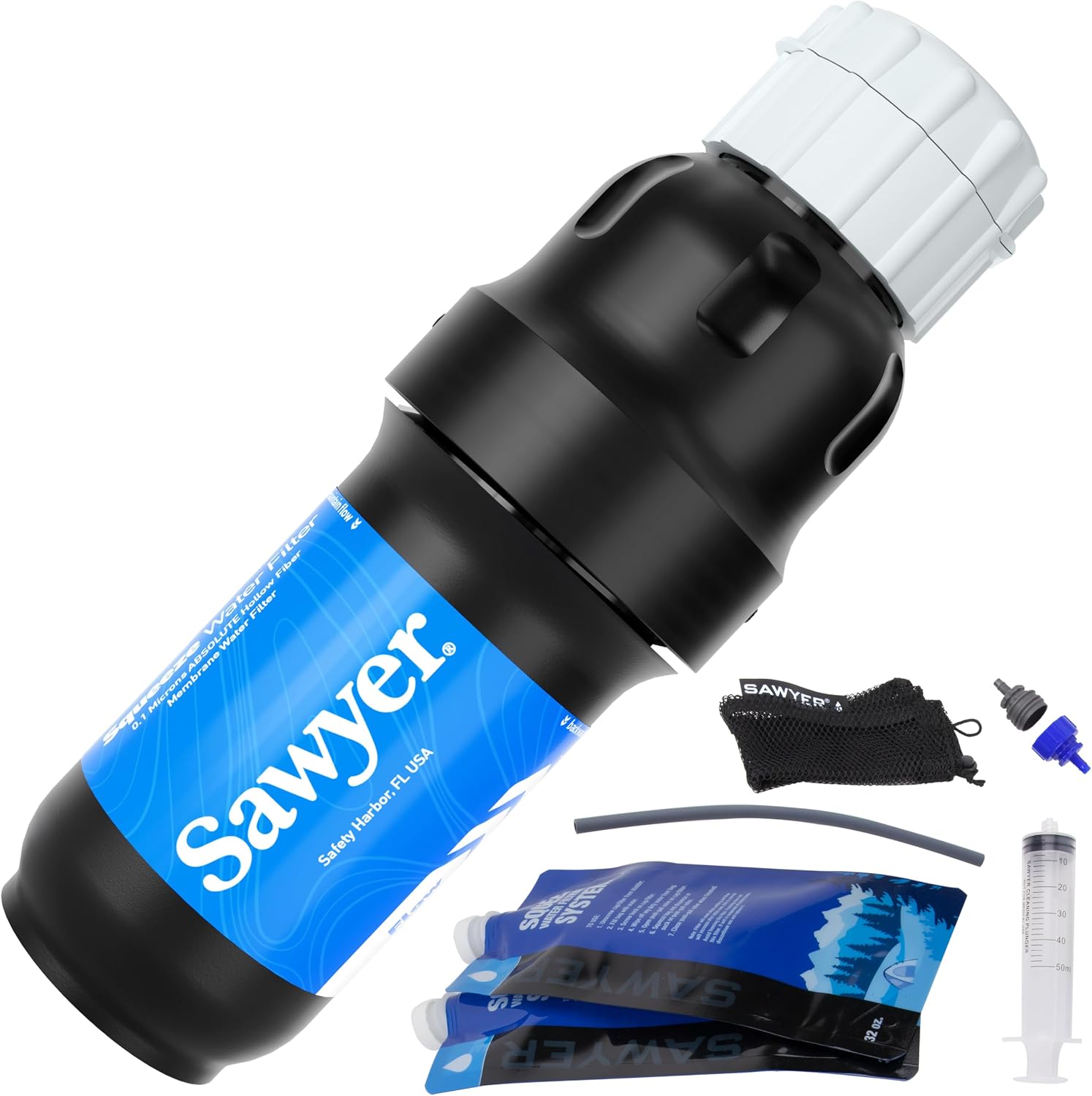
The Sawyer Squeeze is a squeeze-style water filtration system that uses a hollow fiber membrane with 0.1 micron pores. Unlike a straw filter where you suck water directly from a source, the Sawyer Squeeze comes with a reusable 32-ounce pouch. You fill the pouch from a stream or lake, then squeeze the water through the filter into a bottle or directly into your mouth.
Sawyer Products, based in Florida, has been making water filtration systems since 1984. The Squeeze is one of their flagship products and is widely considered the gold standard for ultralight backpackers and preparedness-minded individuals alike.
What makes the Sawyer Squeeze stand out is its versatility and lifespan. The filter is rated for 100,000 gallons – that is a lifetime of water for a single person. It is also backflushable, meaning you can reverse the flow with a syringe (included) to clean out the fibers and restore flow rate. And because it has standard 28mm threads, it screws directly onto most single-wall water bottles, hydration bladders, and even some gravity systems.
Key Specs
- Filter type: Hollow fiber membrane
- Pore size: 0.1 micron
- Lifespan: 100,000 gallons (with backflushing)
- Weight: 2.0 oz (filter only), 4.0 oz with pouch
- Removes: Bacteria (7-log), protozoa (6-log), microplastics
- Does NOT remove: Viruses, chemicals, heavy metals, salt
- Included: Filter, 32 oz reusable pouch, cleaning plunger
- Warranty: Lifetime
Where It Shines
The Sawyer Squeeze is the better choice for anyone who wants a do-everything water filter. You can use it as a straw (drink directly from a source), as a squeeze system (fill pouch, squeeze into bottle), as an inline filter on a hydration bladder, or as part of a gravity system (Sawyer sells a 1-gallon gravity adapter). No other personal filter in this price range offers that kind of flexibility.
For preppers, the 100,000-gallon lifespan is the headline number. Even if you are filtering two gallons of water per day for a family of four, that is over 34 years of use from a single filter. The backflush syringe means the filter can be maintained in the field and will not gradually clog to the point of being unusable, which is a common failure mode for straw-style filters.
Where It Falls Short
The included pouches are the Sawyer Squeeze’s weakest link. They are durable enough for normal use but can develop leaks at the seams over time, especially if you squeeze hard or use them in cold weather. Many users replace them with Evernew or CNOC flexible bottles, which are tougher and easier to fill from shallow water sources.
The filter can also be slow in cold water or when the membrane starts to clog – flow rate drops noticeably before a backflush is needed. In below-freezing temperatures, the hollow fiber membrane can crack if water is left inside it, so you need to drain and store it carefully in winter conditions.
LifeStraw Personal Overview
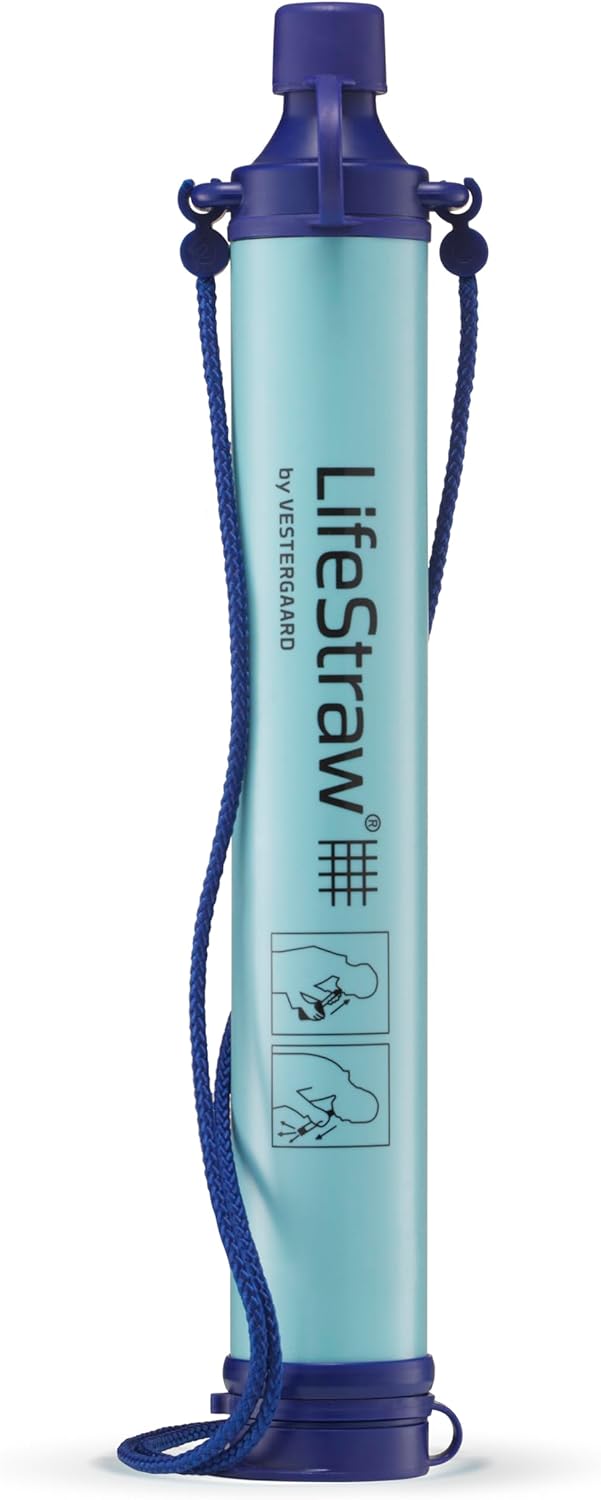
The LifeStraw Personal is a straw-style water filter. You place one end directly into a water source – a stream, a puddle, a lake – and suck water through the filter like drinking through a straw. There is no pouch, no squeeze bottle, no threading onto other containers. It is a single-purpose tool: put it in the water and drink.
LifeStraw is a Swiss company with roots in humanitarian water projects. The original LifeStraw was designed for people in developing countries without access to clean water, and the consumer version brings that same technology to backpackers, travelers, and preppers. The Personal filter has become a genuine cultural phenomenon – it is one of the best-selling outdoor products on Amazon with over 124,000 ratings and a 4.8-star average.
What makes the LifeStraw appealing is its simplicity and price. At around $20, it is one of the cheapest personal water filters on the market. There are no moving parts, no pouches to break, no threading to worry about. You put it in the water and you drink. That is it.
Key Specs
- Filter type: Hollow fiber membrane
- Pore size: 0.2 micron
- Lifespan: 1,000 gallons (4,000 liters)
- Weight: 2.0 oz
- Removes: Bacteria (99.9999%), protozoa (99.99%), microplastics
- Does NOT remove: Viruses, chemicals, heavy metals, salt
- Included: Filter with lanyard
- Warranty: 1 year (manufacturer’s warranty)
Where It Shines
The LifeStraw Personal excels at being a no-fuss backup. It is cheap enough to buy several and stash them in different locations – one in the car, one in a day pack, one in a desk drawer at work. It requires zero maintenance: no backflushing, no cleaning, no pouches to manage. You use it until it reaches 1,000 gallons, then you replace it.
For ultralight hikers who want to shave every possible gram, the LifeStraw is appealing because there is nothing to carry but the filter itself – no pouch, no syringe, no extra parts. And for people who are new to preparedness and want a simple “just in case” item without learning a system, the LifeStraw’s learning curve is effectively zero.
The humanitarian angle is worth mentioning too: for every LifeStraw purchased, the company funds a school child in a developing country with safe water for a school year. For some buyers, that is a meaningful factor.
Where It Falls Short
The LifeStraw Personal has two significant limitations compared to the Sawyer Squeeze.
First, you can only drink directly from the source. You cannot fill a container and filter water to go. If you are at a stream, you drink your fill and move on – but you cannot easily carry filtered water with you unless you bring a separate bottle and pour unfiltered water into it (defeating the purpose). For a day hike, that might be fine. For a bug-out scenario where you need to fill bottles for the road, it is a real problem.
Second, the LifeStraw is not backflushable. As the filter clogs over time, the flow rate will decrease and eventually the filter becomes unusable. There is no way to reverse the flow and clean out the fibers. At 1,000 gallons, the lifespan is adequate for personal backup use, but it is roughly 1% of the Sawyer Squeeze’s rated lifespan. If you are planning for long-term emergency use, that matters.
The 0.2 micron pore size is also slightly larger than the Sawyer’s 0.1 micron. In practice, both filters handle bacteria and protozoa effectively – the difference between 0.1 and 0.2 microns is not clinically significant for the pathogens most likely to make you sick in North American backcountry water. But if you are concerned about smaller bacteria strains, the Sawyer has a slight edge on paper.
Head-to-Head Comparison
Filtration Performance
| Pathogen | Sawyer Squeeze (0.1 micron) | LifeStraw Personal (0.2 micron) |
|---|---|---|
| E. coli | Removed | Removed |
| Salmonella | Removed | Removed |
| Giardia | Removed | Removed |
| Cryptosporidium | Removed | Removed |
| Viruses | NOT removed | NOT removed |
| Chemicals/heavy metals | NOT removed | NOT removed |
Both filters use hollow fiber membrane technology and both are EPA-registered. Neither removes viruses, chemicals, heavy metals, or salt. If you need virus filtration (relevant for international travel or certain contamination scenarios), you would need a different type of filter – typically a pump purifier with an iodine resin or a UV purifier like the SteriPen.
For North American preparedness and backcountry use, both filters handle the pathogens that actually pose a risk: bacteria and protozoa. The Sawyer’s smaller pore size gives it a technical edge, but the real-world difference is negligible for most users.
Winner: Tie (both handle the pathogens that matter; neither handles viruses)
Flow Rate and Ease of Drinking
The Sawyer Squeeze uses squeeze pressure – you compress the pouch to push water through the filter. This generally produces a faster flow rate than suction alone, especially when the filter is clean. You can fill a 1-liter bottle in about 30-60 seconds with a freshly backflushed Sawyer Squeeze.
The LifeStraw relies entirely on suction. You are drawing water through the membrane with your lungs and mouth muscles. For most people, this is fine for drinking directly, but it is noticeably slower than squeeze pressure and can be tiring if you are trying to drink a large volume of water quickly.
Winner: Sawyer Squeeze (squeeze pressure is faster and less effort)
Versatility
This is where the Sawyer Squeeze pulls far ahead. The Sawyer can be used five different ways:
- Straw mode – drink directly from a water source (like the LifeStraw)
- Squeeze mode – fill the pouch and squeeze filtered water into a bottle
- Inline mode – attach it to a hydration bladder hose
- Bottle mode – screw it onto standard 28mm water bottles (Smartwater, Dasani, etc.)
- Gravity mode – hang it in a gravity system for group filtering
The LifeStraw Personal has one mode: drink directly from the source.
For a backpacker, the Sawyer’s ability to thread onto a cheap Smartwater bottle is a huge advantage. For a prepper, the gravity mode means you can filter water for a whole family without standing at a stream squeezing for 20 minutes.
Winner: Sawyer Squeeze (by a wide margin)
Durability and Lifespan
The Sawyer Squeeze is rated for 100,000 gallons and is backflushable, meaning you can clean it in the field and restore flow rate as it clogs. With proper maintenance – backflush after every trip, store dry, keep from freezing – a single Sawyer Squeeze can last decades.
The LifeStraw Personal is rated for 1,000 gallons and is not backflushable. Once the flow rate drops to unusable, the filter is done. For casual use (a few camping trips per year), 1,000 gallons will last a long time. For regular or emergency use, you will need to replace it.
Both filters can be damaged by freezing if water is left inside the hollow fiber membrane. In cold weather, both need to be drained and stored carefully.
Winner: Sawyer Squeeze (100x the rated lifespan, plus field-maintainable)
Weight and Packability
Both filters weigh approximately 2 ounces. However, the total carried weight differs based on what else you need:
- Sawyer Squeeze: 2.0 oz (filter) + 2.0 oz (pouch) + 0.5 oz (cleaning syringe) = ~4.5 oz total
- LifeStraw Personal: 2.0 oz (filter only, nothing else needed)
If you are counting every gram for an ultralight kit, the LifeStraw is lighter because it does not require a pouch. However, the Sawyer’s pouch doubles as a water container, so you may actually save weight by not needing a separate bottle.
Winner: LifeStraw (slightly, for true minimalists)
Price and Value
- Sawyer Squeeze: ~$37 (includes filter, 32 oz pouch, cleaning syringe)
- LifeStraw Personal: ~$20 (filter only)
The LifeStraw is significantly cheaper up front. But when you factor in lifespan, the value equation shifts:
- Sawyer: $37 / 100,000 gallons = $0.00037 per gallon
- LifeStraw: $20 / 1,000 gallons = $0.02 per gallon
Per gallon filtered, the Sawyer Squeeze is approximately 54 times more cost-effective. Even if you never come close to the Sawyer’s rated lifespan, the backflushing capability means you will get many times more use out of it than the LifeStraw.
That said, the LifeStraw’s low price makes it practical to buy multiple units and stage them in different locations (car, office, backpack, glove compartment). You might not do that with a $37 filter.
Winner: Sawyer Squeeze (for long-term value); LifeStraw (for low upfront cost and staging multiple units)
Which Should You Choose?
Choose the Sawyer Squeeze if:
- You are building a bug-out bag and need to filter water into bottles for the road
- You want a single filter that lasts a lifetime with minimal maintenance
- You plan to filter water for a group or family (pair it with a gravity system)
- You want to screw a filter onto a standard water bottle (Smartwater, Dasani, etc.)
- You are backpacking and want the fastest, most versatile filtration method
- You want the best long-term value per gallon filtered
Check Sawyer Squeeze price on Amazon
Choose the LifeStraw Personal if:
- You want a cheap, no-fuss backup to stash in multiple locations
- You need the simplest possible filter – no learning curve, no parts to manage
- You are on a tight budget and need something under $25
- You want a filter for direct drinking only (stream side, not filling bottles)
- You want to support humanitarian water programs (LifeStraw’s give-back program)
Check LifeStraw Personal price on Amazon
Consider getting both:
Many experienced preppers and backpackers carry both. The Sawyer Squeeze is your primary filtration system – the one you use for filtering water into bottles, cooking, and group use. The LifeStraw is your backup – a cheap, lightweight insurance policy you keep in your day pack, your car kit, or your get-home bag in case your primary filter is lost, damaged, or you are separated from your main kit.
Other Water Filters Worth Considering
If neither the Sawyer Squeeze nor the LifeStraw is exactly what you need, here are two alternatives worth a look:
Sawyer Mini Water Filtration System
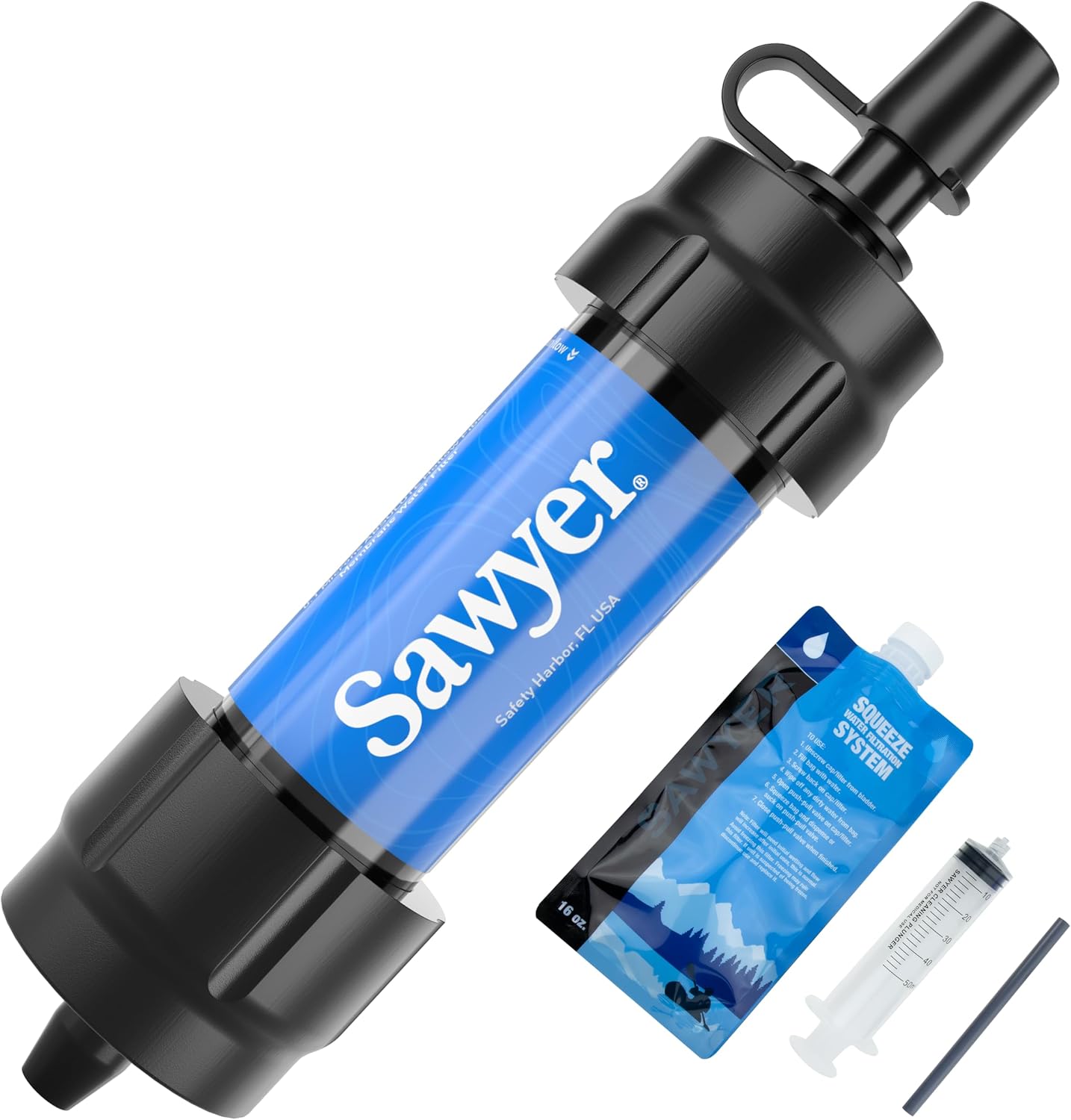
The Sawyer Mini is a smaller, lighter version of the Squeeze with the same 0.1 micron filtration and 100,000-gallon lifespan. It has a smaller diameter and a slower flow rate, but it weighs just 1.8 ounces and is ideal for ultralight kits where every gram matters. It threads onto the same 28mm bottles as the full-size Squeeze.
Katadyn BeFree 1.0L Collapsible Water Filter Bottle
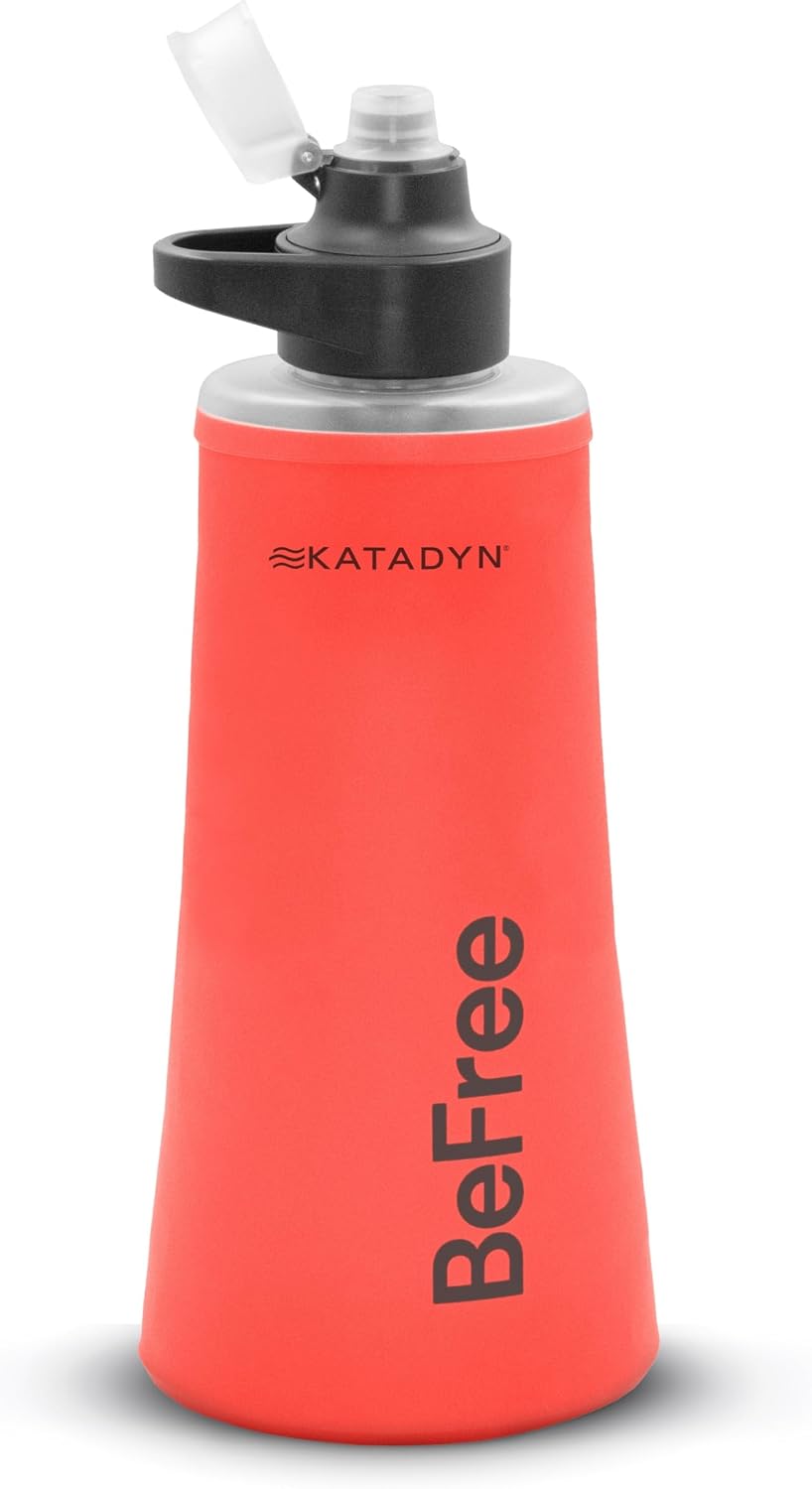
The Katadyn BeFree is a squeeze bottle with an integrated 0.1 micron filter. It has a much faster flow rate than the Sawyer Squeeze (thanks to a wider membrane) and is easier to drink from on the go. The trade-off is a shorter lifespan – it is rated for 1,000 liters (about 264 gallons) and is not backflushable in the traditional sense, though you can swish it in clean water to improve flow. It is an excellent choice for day hikes and travel, but less ideal for long-term emergency preparedness.
FAQ
Can the Sawyer Squeeze or LifeStraw remove viruses?
No. Neither filter removes viruses. Both use hollow fiber membranes with pore sizes (0.1 and 0.2 microns) that block bacteria and protozoa but are too large to catch viruses, which are typically 0.01 to 0.1 microns. If you are concerned about viral contamination (more common in developing countries or in areas with sewage contamination), you will need a water purifier that uses chemical treatment (iodine or chlorine dioxide), UV light (like a SteriPen), or a pump purifier with a virus-rated membrane.
How long does the Sawyer Squeeze filter last?
The Sawyer Squeeze is rated for 100,000 gallons. With regular backflushing using the included cleaning syringe, the filter can maintain good flow rate for years of regular use. In a preparedness scenario where you are filtering a few gallons per day, a single filter could last years to decades. The key is proper maintenance: backflush after every trip, let it dry completely before storage, and protect it from freezing.
How long does the LifeStraw last?
The LifeStraw Personal is rated for 1,000 gallons (approximately 4,000 liters). There is no way to backflush or clean the filter, so once the flow rate drops to the point where it is difficult to draw water through, the filter has reached the end of its life. For occasional use (a few camping trips per year), this could last several years. For regular or heavy use, plan on replacing it more frequently.
Can I use the Sawyer Squeeze in cold weather?
Yes, but with caution. The hollow fiber membrane can crack if water freezes inside it. In cold weather (below freezing), drain the filter completely after each use and keep it close to your body (inside your jacket) to prevent residual water from freezing. Do not leave it exposed in a pack overnight in freezing temperatures.
Can I drink saltwater with either filter?
No. Neither the Sawyer Squeeze nor the LifeStraw removes salt. They are designed for fresh water only. If you need to desalinate water, you would need a reverse osmosis system or a solar still.
Which filter is better for a bug-out bag?
The Sawyer Squeeze is generally the better choice for a bug-out bag because it can filter water into bottles for the road, it works as part of a gravity system for group use, and its 100,000-gallon lifespan means you will not need to carry a replacement filter. However, many preppers carry a LifeStraw as a secondary backup because it is cheap, light, and requires no maintenance.
Are these filters EPA registered?
Yes. Both the Sawyer Squeeze and the LifeStraw Personal are tested and certified to EPA standards for water filtration. They have been independently verified to remove bacteria and protozoa to the claimed percentages.
The Bottom Line
For most people building an emergency preparedness kit, the Sawyer Squeeze is the better choice. Its versatility (five ways to use it), longevity (100,000 gallons with backflushing), and ability to filter water into containers make it a more practical tool for real emergency scenarios where you need to filter water for drinking, cooking, and hygiene – not just take a quick drink at a stream.
The LifeStraw Personal is not a bad product – it is an excellent, affordable, dead-simple backup filter that has earned its popularity. But its limitations (single-use drinking only, not backflushable, 1,000-gallon lifespan) make it better suited as a secondary filter or a “stash it and forget it” emergency item rather than a primary water filtration system.
Our recommendation: Get a Sawyer Squeeze as your primary filter, and consider adding a LifeStraw as a backup in a separate location (car kit, get-home bag, office drawer). That way you have the versatility and lifespan of the Sawyer for your main kit, plus a cheap, lightweight insurance policy if you are ever separated from it. For more on building a complete emergency kit, see our guide to the best emergency radios – another essential piece of gear that works when cell phones fail.